
AGFRC 20A BLHeli_S DSHOT600 ESC for FPV Drone (XR-20A)
4.3Editor score
Compact and lightweight
Multiple protocol support
Smooth throttle response
This guide compares the top Escs for Racing Quadcopter models available in October 2026, evaluating performance, features, and reliability to help you choose
Choosing the right Electronic Speed Controller is critical for any racing quadcopter build. These components manage motor power delivery, influencing throttle response and overall flight stability. A high quality ESC ensures smooth operation and protects your motors from electrical spikes during aggressive maneuvers.
We analyzed ten leading models based on firmware support, current capacity, and build quality. Each product offers unique advantages for different flight styles and budgets. Our comparison focuses on real world performance characteristics that matter most to competitive pilots and hobbyists.
Every selection highlights key strengths and potential trade-offs for your specific needs. Note that market conditions can cause product availability and pricing to shift over time. Always verify current specifications before purchasing to ensure compatibility with your existing flight controller and battery setup.
4.3Editor score

5.0Editor score

4.0Editor score
This side-by-side comparison highlights the essential specifications of each model to help you identify the best fit for your racing quadcopter project. We focused on amperage ratings, supported protocols, and physical dimensions.




This ESC is a popular choice for builders seeking reliable performance without breaking the budget. It comes with BLHeli_S firmware preloaded, making updates straightforward via the signal cable. Its compact size makes it ideal for tight racing builds where weight savings are critical.
We may earn a commission when you buy through this link, at no additional cost to you.
The hardware PWM drive contributes to a smooth throttle response and minimal audible noise during flight. You can configure it to support various digital protocols like DShot600 and Oneshot. This flexibility ensures compatibility with most modern flight controllers used in FPV racing.
While it handles 20 amps continuously, it may struggle with high power motors or larger batteries. The thermal design is adequate for standard racing but not for prolonged high heat scenarios. However, for typical short race flights, these trade-offs are generally acceptable.
If you are building an entry-level racing quad or need multiple units for a fleet, this ESC offers the best balance of cost and features. It performs well with 2-4S setups and provides enough headroom for standard racing motors.
You can upgrade or flash the firmware directly through the ESC signal cable, saving time during maintenance.
Hardware PWM drive motor reduces noise and improves sensitivity, making throttle control more precise.
We may earn a commission when you buy through this link, at no additional cost to you.
The MAD AMPX 40A Pro stands out with a perfect rating from users who value consistency and performance. It uses a new core software specifically designed to improve throttle response for quadcopters. This makes it a top choice for pilots demanding precise control during high-speed races.
We may earn a commission when you buy through this link, at no additional cost to you.
It supports a wide range of flight controllers with a signal frequency requirement above 600Hz. The adaptive default settings like auto-adjusting timing simplify configuration for most applications. This reduces setup time and helps avoid common tuning issues for new builds.
The 40A rating is sufficient for most 5-inch racing quads using 4S or 6S batteries. While it is a bit larger than micro ESCs, the performance gains justify the size. Crosstalk reduction features ensure cleaner signal transmission, preventing unwanted motor hiccups.
For builders prioritizing reliability and throttle precision, this ESC is an excellent choice. It handles higher voltage setups well and provides a stable platform for competitive racing. The robust firmware ensures long-term reliability under stress.
New core software optimizes throttle response, providing smoother control during aggressive maneuvers.
Crosstalk reduction technology minimizes interference, ensuring consistent motor performance.
We may earn a commission when you buy through this link, at no additional cost to you.
This ESC is designed for heavy-duty applications where extreme power and reliability are non-negotiable. It supports 4-8S LiPo batteries and delivers a continuous 160A per channel. This makes it suitable for large racing drones or builds with high KV motors demanding significant current.
We may earn a commission when you buy through this link, at no additional cost to you.
A built-in ammeter allows for telemetry transmission, giving you real-time updates on motor speed and current. This feature helps monitor performance during flight and detect potential issues early. The dual-pad power design simplifies welding and improves current carrying capacity.
The large metal heat sink ensures stable output even during extended high-power usage. While it is significantly more expensive and larger than standard racing ESCs, it offers unmatched protection for your motors. This reliability is crucial for professional or competitive racing environments.
If you are building a high-voltage racing quad and need the best protection against electrical stress, this is the premium choice. It delivers consistent performance under extreme loads and provides valuable telemetry data for flight analysis.
Built-in ammeter supports telemetry transmission for real-time motor and battery monitoring.
Large metal heat sink ensures stable performance even during prolonged high-power output.
We may earn a commission when you buy through this link, at no additional cost to you.
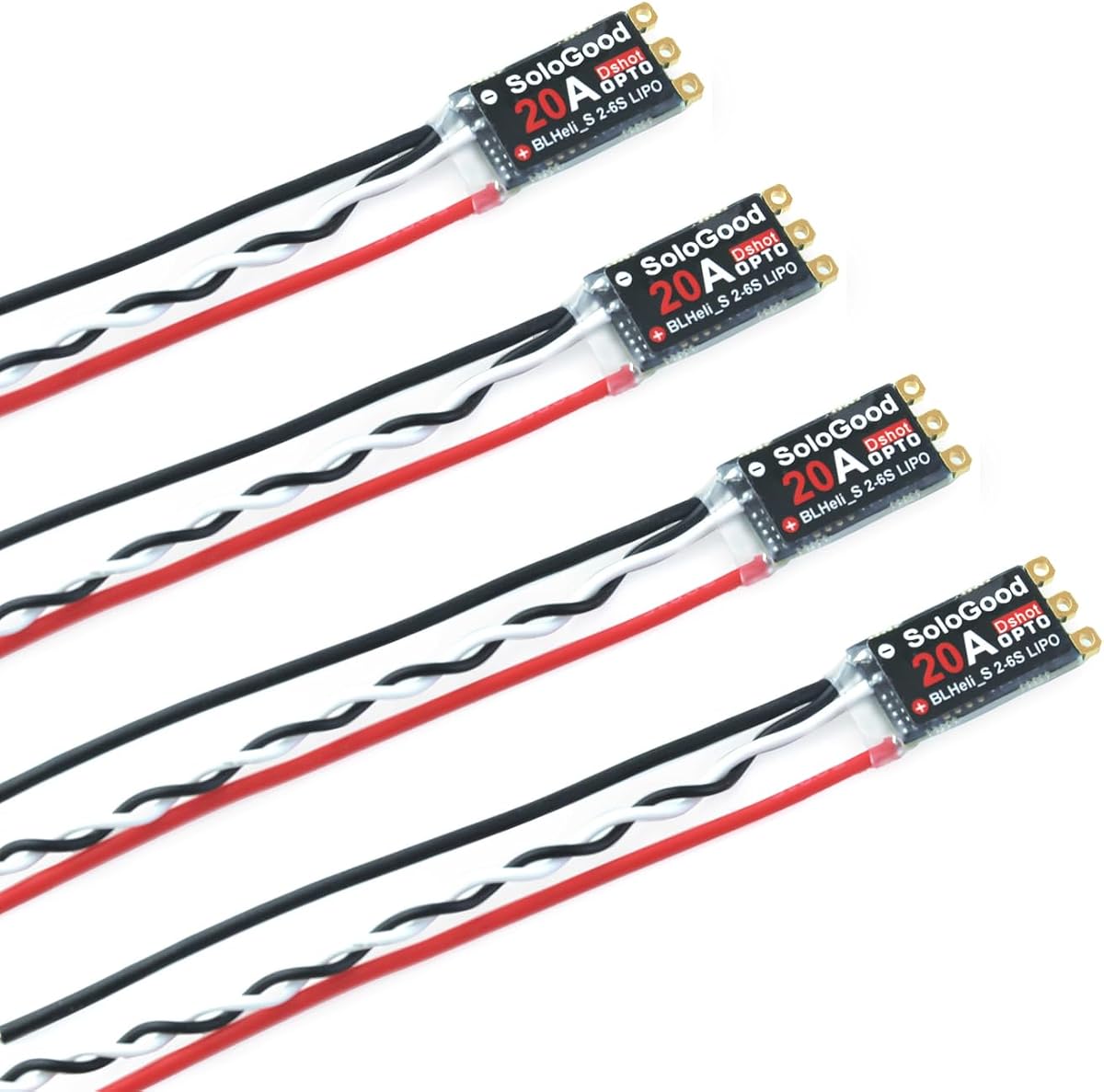
This kit provides four ESCs suitable for a complete quadcopter build at a reasonable cost. It uses original components to ensure high current capability and durability. The BLHeli_S firmware allows easy upgrades via the signal cable, simplifying maintenance for pilots.
We may earn a commission when you buy through this link, at no additional cost to you.
The twisted pair throttle signal cable reduces crosstalk, leading to more stable operation during high-throttle racing. You can set the throttle range to match different receivers, ensuring smooth speed control. This flexibility makes it compatible with a wide range of FPV setups.
While primarily optimized for multi-axis drones, it also supports fixed-wing and helicopters well. The 2-4S LiPo range covers most entry-level and intermediate racing drones. However, pilots should be mindful of the 20A limit with larger or more powerful motors.
If you need a complete set of ESCs for a new quad, this offers good value and reliability. It handles standard racing conditions well and provides a stable platform for learning or competing.
Twisted pair cable reduces crosstalk, ensuring clean signal transmission during flight.
Supports multi-axis, fixed-wing, and helicopters for versatile use in different projects.
We may earn a commission when you buy through this link, at no additional cost to you.
The HGLRC 60A ESC is a powerful option for pilots transitioning to 6S racing batteries. It supports a range of digital protocols including DShot600, 300, and 150, ensuring compatibility with most flight controllers. The immersion gold design offers better resistance to high temperatures and current.
We may earn a commission when you buy through this link, at no additional cost to you.
Large ESC pads allow for direct plug-in connections to the flight controller, eliminating the need for soldering in some cases. This feature speeds up assembly and reduces the risk of solder joint failures during high-vibration flights. It delivers stable output for powerful flight performance.
While it is heavier than 20A options, the 60A rating gives you significant headroom for high KV motors. This ensures you can push your drone to its limits without risking ESC burnout. The robust design makes it a reliable choice for demanding freestyle or racing builds.
If you are upgrading to a 6S system or need more power for high-speed flying, this ESC provides the necessary capacity. It balances performance and reliability effectively for intermediate to advanced pilots.
Immersion gold design increases resistance to high temperature and current stress.
Large direct pads allow for direct plug-in connections, reducing soldering hassles.
We may earn a commission when you buy through this link, at no additional cost to you.
The LittleBee ESC is known for its incredibly compact footprint, making it ideal for tight racing builds where space is limited. It measures just 23x12x4mm and integrates seamlessly into small frames without adding unnecessary weight. The preloaded BLHeli_S firmware simplifies setup and updates.
We may earn a commission when you buy through this link, at no additional cost to you.
Support for DShot protocol ensures fast and responsive digital signals for precise control. The muted mode feature allows for quieter, more efficient operation during flight. This reduces noise pollution while maintaining the high performance expected from racing quads.
With a continuous rating of 20A and a burst of 25A, it handles short high-power bursts well. This is perfect for quick acceleration and maneuvering during competitive races. However, prolonged high-power usage may exceed its limits if not monitored.
If weight and size are your top priorities, this ESC delivers excellent performance in a tiny package. It is a strong contender for 2S to 4S racing builds that demand agility and responsiveness.
Muted mode provides quieter operation while maintaining high performance efficiency.
Tiny footprint integrates seamlessly into tight racing builds without adding bulk.
We may earn a commission when you buy through this link, at no additional cost to you.
This ESC uses high-quality hardware including an EFM8BB21 MCU for reliable operation at high speeds. It supports multiple throttle modes like DShot300 and Oneshot42 to match your flight controller preferences. The 55A continuous current provides plenty of power for racing applications.
We may earn a commission when you buy through this link, at no additional cost to you.
Dedicated 3-in-1 driver IC helps ensure smoother starting, which is critical for consistent race performance. The firmware is optimized for multirotors to enhance performance and reduce noise. This makes it a robust choice for pilots seeking reliability in competitive settings.
While it is not as feature-rich as some premium options, it delivers consistent performance at a reasonable price. The dimensions are suitable for most standard racing frames, and the weight is manageable. It offers a solid middle ground for performance and cost.
If you need a reliable ESC with good power handling and standard features, this is a great option. It performs well across various battery configurations and ensures stable flight during high-speed maneuvers.
High-quality EFM8BB21 MCU and 8-bit core ensure stable operation at high frequencies.
Dedicated driver IC improves starting smoothness for better performance during takeoff.
We may earn a commission when you buy through this link, at no additional cost to you.
This ESC uses the AT32F421 32-bit processor to deliver efficient and high-performance operation. It supports PWM frequencies from 8 KHz to 96 KHz, allowing for fine-tuned motor control. The 65A rating gives you good headroom for most racing setups using 6S batteries.
We may earn a commission when you buy through this link, at no additional cost to you.
Multi-layer PCB design helps with over-current capability and heat dissipation during flight. The angled solder pads simplify the installation process and reduce the risk of soldering errors. High-power MOSFETs ensure ultra-high efficiency conversion, extending flight time.
While the user rating is average, the technical specifications suggest strong performance potential. It is compatible with standard digital protocols and offers good flexibility for configuration. This makes it suitable for pilots who want modern features and efficient power management.
If you are looking for an ESC with a modern processor and efficient design, this model is worth considering. It provides the capacity needed for aggressive racing while maintaining energy efficiency.
AT32F421 processor enables wide PWM frequency support for precise control.
High-power MOSFETs reduce losses and extend flight time through efficient conversion.
We may earn a commission when you buy through this link, at no additional cost to you.
This stack integrates a flight controller and 70A ESC into a single compact unit, simplifying wiring and setup. It supports up to 8 motors and provides independent power for VTX systems via dual BEC outputs. The built-in black box records flight data for performance analysis after each race.
We may earn a commission when you buy through this link, at no additional cost to you.
With support for 4-8S LiPo batteries, it offers versatile power options for various drone sizes. The angled solder pads reduce welding difficulty, making installation easier for complex builds. The supported LED feature allows for WS2812 LED control via Betaflight firmware.
While it has a lower rating due to complexity and potential setup challenges, the features are robust. It is a good choice for pilots who want an all-in-one solution with advanced telemetry capabilities. The MCU and sensor combination ensures reliable flight data recording.
If you want to reduce wiring complexity and need advanced features like telemetry and black box recording, this stack is a strong candidate. It is suitable for those who are comfortable with integrated systems.
Flight controller and ESC are combined to simplify wiring and reduce build time.
Built-in black box ensures effective recording of flight data for analysis.
We may earn a commission when you buy through this link, at no additional cost to you.
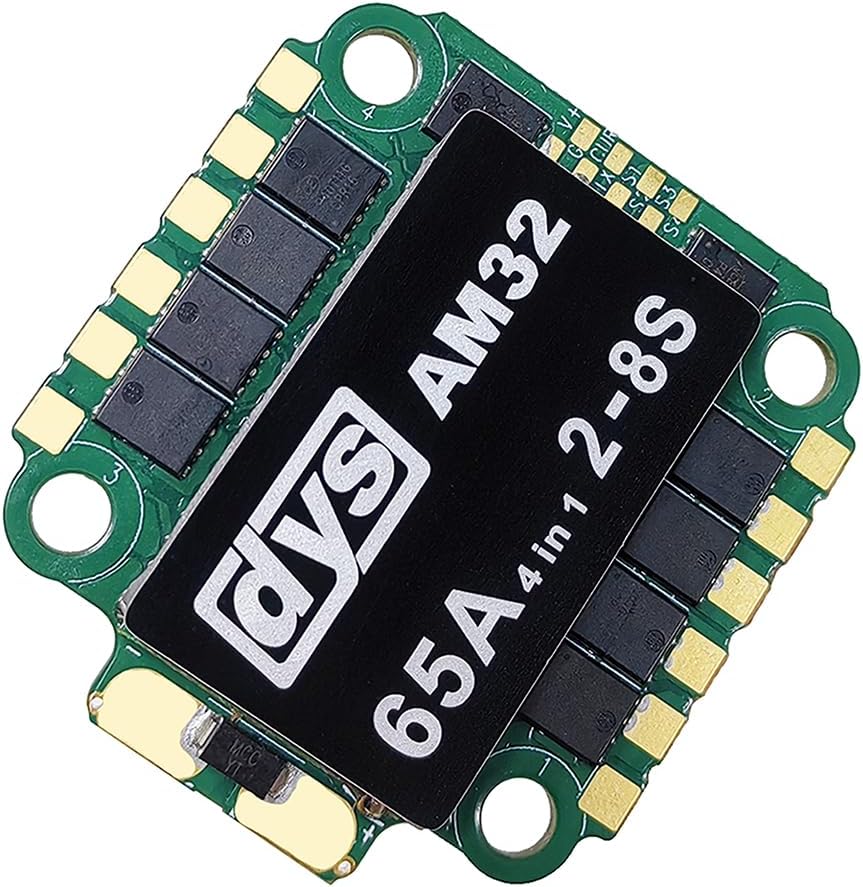
This ESC uses AM32 firmware which offers a 32-bit architecture for precise control and robust performance. It supports a wide range of 2-8S LiPo batteries, making it versatile for different builds. The MOS upgrade provides a 15% performance improvement over previous versions.
We may earn a commission when you buy through this link, at no additional cost to you.
The physical design fits standard 30.5×30.5mm frames with convenient installation holes. It is designed for both racing and freestyle flying, offering a balance of power and control. The 65A continuous rating is sufficient for most high-performance racing setups.
While the user rating is lower, the specifications suggest it has the potential for strong performance if configured correctly. Some users may face firmware or compatibility hurdles, but the 32-bit support is a significant advantage. This makes it a technical choice for enthusiasts.
If you need an ESC with AM32 firmware support and wide battery compatibility, this model is a viable option. It provides the power needed for high-end racing with modern control features.
AM32 firmware offers 32-bit precision control and improved performance characteristics.
Supports 2-8S LiPo for versatile power options in different racing builds.
We may earn a commission when you buy through this link, at no additional cost to you.
Selecting the right ESC involves balancing performance, size, and features. We break down the key factors that will help you choose the most suitable model for your racing needs.
The continuous current rating determines how much power the ESC can handle over time. For standard 5-inch racing quads, 40A to 55A is usually sufficient. Higher ratings offer a safety margin for larger motors or high-throttle racing.
Always choose an ESC with a rating higher than your motor's maximum draw to prevent burnout.
Check the supported LiPo range to ensure compatibility with your battery setup. Many racing ESCs support 2-4S or 2-6S batteries. Higher voltage support allows for more aggressive builds with 6S setups.
Verify that your ESC can handle your battery's maximum voltage to avoid damage.
Modern ESCs support protocols like DShot, which provides cleaner digital signals. Ensure the ESC supports DShot600 or higher for responsive control. Most support standard PWM and Oneshot protocols for broad compatibility.
Confirm firmware compatibility with your flight controller to ensure smooth operation.
The footprint of the ESC must fit within your frame's limits. Smaller ESCs reduce weight but may have less thermal capacity. Mounting holes should match standard 30.5×30.5mm spacing.
Measure your frame carefully to ensure the ESC fits without obstructing other components.
Effective heat dissipation is critical to prevent failure during long races. Look for ESCs with good PCB design or heatsinks. Thermal stress can degrade performance if the ESC overheats during flight.
Ensure your ESC has adequate ventilation and thermal protection for your flying conditions.
Many modern ESCs feature direct plug-in pads to reduce soldering. This simplifies assembly and reduces the risk of bad joints. Ensure the wiring length matches your build layout for easy installation.
Choose an ESC with wiring and connectors that fit your specific build requirements.
Some premium ESCs offer built-in ammeters or telemetry support. This allows you to monitor current and temperature in real time. Advanced features can help you optimize performance and protect your motor.
Consider whether telemetry is necessary for your level of flying and data logging needs.
Install the ESC on a flat, stable surface with good airflow to ensure proper cooling. Secure it firmly to prevent vibration from affecting solder joints or performance. Ensure power and signal connections are clean and tight.
Configure your ESC firmware using a compatible Betaflight configurator to match your motor and receiver settings. Verify the DShot protocol and timing settings to ensure accurate throttle response. Test the motor direction and spin-up before flying.
Regularly inspect your ESC for signs of wear, burns, or loose wires. Keep connectors clean and check for debris that might cause short circuits. Avoid overloading the ESC by matching it to appropriate motor and battery combinations.
DShot sends digital signals that are more reliable and faster than analog PWM signals. This reduces noise and interference during high-speed flight. It allows for better motor control and telemetry capabilities.
It depends on your ESC design. Some modern ESCs offer direct plug-in pads that reduce soldering needs. Traditional models require soldering power and signal lines to your flight controller or battery.
Select an ESC with a continuous rating at least 20% higher than your motor's maximum current draw. This prevents overheating and extends the life of your electronics. Racing ESCs often handle burst currents higher than their continuous rating.
Yes, most ESCs support a range of battery voltages. If it supports 2-6S, it will work with 4S batteries without issues. Just ensure the ESC is configured correctly for your specific setup.
Updating firmware ensures you have the latest bug fixes and performance optimizations. It allows you to enable new protocols like DShot or BLHeli features. This keeps your ESC compatible with new flight controllers.
Overheating can cause the ESC to throttle down or shut off unexpectedly. This results in a loss of power or a crash mid-flight. Good thermal management and adequate airflow are essential to prevent this.
We've explored the top ten models for racing quadcopters available in November 2026. The MAD AMPX 40A Pro offers the best overall performance, while the AGFRC 20A BLHeli_S provides exceptional value for budget builders.
Prioritize current rating and firmware support to ensure your drone performs reliably under stress. Choose an ESC that matches your motor and battery specifications to avoid damage and achieve optimal flight characteristics.
Always check current prices and availability as they can change over time. With the right ESC, your racing quadcopter will deliver the smooth and responsive power needed for competitive flying.