
FNIRSI HRM-10 Precision Voltage Internal Resistance Battery Tester
4.4Editor score
Automated voltage and resistance testing
TFT HD color display
Kelvin four-wire connection method
This guide compares the top battery internal resistance testers for accuracy, features, and value to help you choose the right diagnostic tool for your needs.
Choosing the right battery internal resistance tester is crucial for maintaining reliable power sources across various applications. These devices measure the internal resistance of batteries to determine their health and capacity without causing damage. Whether you work with automotive batteries or small consumer cells, accurate testing ensures safety and performance.
We evaluated ten leading models based on measurement precision, ease of use, display quality, and connectivity options. Each product was assessed for its ability to handle different battery types and provide clear, actionable data. Our goal is to help you find a tester that fits your specific workflow and budget requirements.
Each pick in this list highlights key features, pros, cons, and ideal use cases for detailed comparison. We focus on real-world performance and user feedback to ensure our recommendations are practical and reliable. Please note that product availability and pricing may change frequently so verify current details before purchasing.
4.4Editor score

4.5Editor score

2.2Editor score
The following table provides a side-by-side comparison of all ten selected battery internal resistance testers to highlight their core specifications and capabilities at a glance.




The ZOYI ZT-XR1 stands out as a versatile tool combining a 25000-count multimeter with battery internal resistance testing capabilities. It holds a strong 4.5-star rating reflecting user satisfaction with its precision and functionality. This device allows professionals and hobbyists to diagnose battery health and electronic circuits with a single unit.
We may earn a commission when you buy through this link, at no additional cost to you.
Its standout feature is the 4-wire Kelvin sensing which ensures accurate resistance measurements by eliminating lead resistance errors. The device supports a wide range of battery types from lithium to lead-acid making it highly adaptable. Users appreciate the built-in 2000mAh battery which offers up to ten hours of runtime on a single charge.
While the price is higher than basic testers the added functionality of a full multimeter justifies the cost for many users. The adjustable brightness TFT screen ensures readability in various lighting conditions including direct sunlight. Some users might find the menu system slightly complex when only simple voltage checks are needed.
This tester is ideal for electricians and repair professionals who need comprehensive diagnostic tools in one portable package. The ability to store data and analyze trends adds significant value for maintenance workflows. We recommend this for anyone needing precision and versatility in their battery testing routine.
The 4-wire Kelvin sensing method removes contact resistance errors ensuring reliable results for low resistance batteries.
A built-in 2000mAh rechargeable battery supports long field work sessions without needing constant AC power access.
We may earn a commission when you buy through this link, at no additional cost to you.
The FNIRSI HRM-10 offers an affordable entry point for users needing reliable battery internal resistance testing without advanced features. With a 4.4-star rating it is praised for its ease of use and clear display. This model automatically tests voltage and resistance simultaneously simplifying the diagnostic process for most standard batteries.
We may earn a commission when you buy through this link, at no additional cost to you.
Its TFT HD color display presents test results vividly making it easy to read even in low light. The Kelvin four-wire connection method improves accuracy by avoiding wire and contact resistance issues common in cheaper testers. Users can manually adjust voltage and resistance ranges for customized testing scenarios.
This device stores historical records allowing you to track battery degradation over time effectively. However it relies on an external power source rather than an internal battery which may limit portability in some field situations. The build is functional but feels less rugged than premium industrial models.
Ideal for hobbyists and small shop owners this tester balances cost and performance well. It supports various battery types from household to automotive making it versatile. We recommend it for those seeking a straightforward device with accurate readings at a budget-friendly price.
Automatic measurement of voltage and resistance reduces user error and speeds up the testing workflow.
Historical record storage helps identify trends in battery health over extended periods of use.
We may earn a commission when you buy through this link, at no additional cost to you.
The T-685 positions itself as a high-end analytical tool for users requiring extreme precision in battery resistance testing. Although it carries a lower user rating it offers specifications like a 1uΩ to 200Ω range that are rare in consumer models. This device measures both AC and DC resistance providing deeper insights into battery performance.
We may earn a commission when you buy through this link, at no additional cost to you.
Its ability to connect to a computer via USB allows for detailed data logging and analysis which is vital for research or quality control. The voltage range of 1mV to 100V DC covers almost every conceivable battery type from tiny button cells to large packs. Users benefit from automatic range switching which simplifies operation despite advanced features.
The complexity of this unit may deter casual users who only need basic checks. The lower rating suggests potential learning curves or reliability concerns reported by some early adopters. However for those needing laboratory-grade features the feature set is unmatched in this price class.
We recommend this tester for professional labs or technicians working on specialized lithium packs. It offers functionality that standard testers cannot match including detailed resistance profiling. Ensure you have the expertise to interpret AC resistance data before purchasing this premium device.
A minimum resolution of 1uΩ allows detection of minute resistance changes indicating subtle battery aging.
USB connectivity enables exporting data to PCs for long-term trend analysis and reporting.
We may earn a commission when you buy through this link, at no additional cost to you.
The WESTOBIG tester emphasizes precision and data management for automotive and universal battery testing. Its 4.3-star rating indicates solid performance for standard diagnostic tasks. The device utilizes upgraded Kelvin four-terminal sensing to ensure accurate readings even for low resistance values.
We may earn a commission when you buy through this link, at no additional cost to you.
Users can preset eight sets of data to quickly check if batteries meet specific standards without manual input each time. This feature significantly speeds up bulk testing processes in workshops or maintenance shops. Data can be transferred to a PC via Excel for further analysis and record keeping.
The color display is clear but relies on external power which limits mobility compared to battery-powered models. While the Excel export is a strong point for some the software integration may be basic for complex reporting needs. It balances features well for professional automotive use cases.
We recommend this model for mechanics who need quick pass-fail testing for car batteries. The ability to set custom data thresholds is particularly useful for quality control. It is a practical choice for those prioritizing data handling alongside standard measurement accuracy.
Preset data sets reduce the time needed to configure tests for repeated battery types.
Exporting data to Excel helps maintain organized records for warranty or service purposes.
We may earn a commission when you buy through this link, at no additional cost to you.
The Dlyfull battery tester offers exceptional versatility with support for eleven different battery types ranging from common AA cells to specialized 9V. It holds a 4.4-star rating reflecting its ease of use and reliability for general household and consumer electronics needs. The rotary dial makes selecting the correct mode quick and intuitive.
We may earn a commission when you buy through this link, at no additional cost to you.
One unique feature is the ability to detect battery capacity percentage which helps users understand remaining charge levels beyond simple voltage. This can prevent overcharging of rechargeable batteries extending their lifespan. The large LCD screen provides clear feedback in various lighting conditions.
While simple the device lacks data storage capabilities meaning test results are not retained after power off. Manual selection via the dial can be slightly slower than automated models when switching between vastly different battery types. However its simplicity is a strong point for non-technical users.
We recommend this tester for home use where multiple battery types are common. It is cost-effective and straightforward for checking device power sources regularly. For users needing detailed historical data it may be less suitable than advanced models.
The rotary dial interface removes the need for complex menu navigation making it accessible for everyone.
Capacity percentage detection offers a more useful metric than voltage alone for rechargeable cells.
We may earn a commission when you buy through this link, at no additional cost to you.
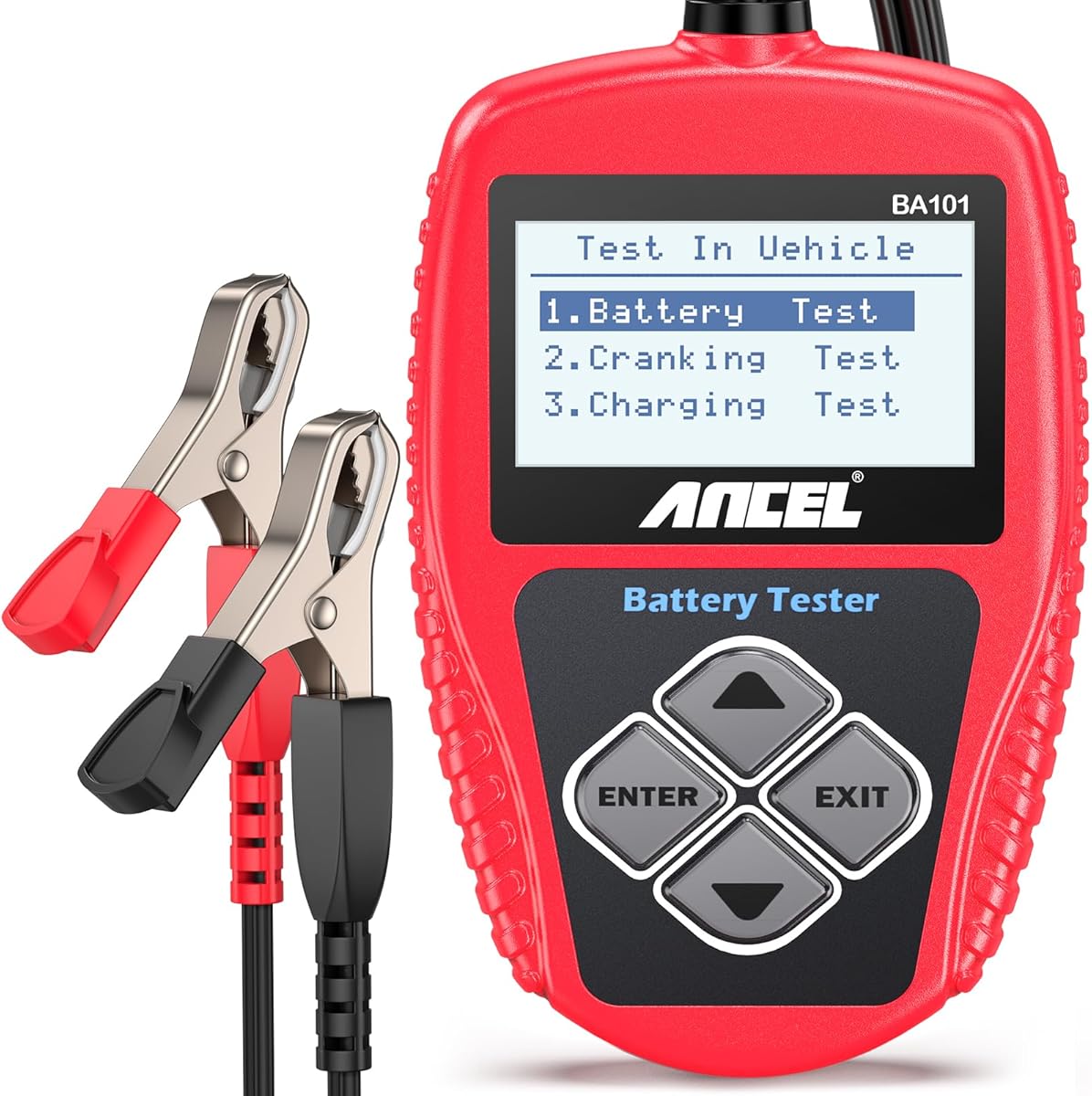
The ANCEL BA101 is designed specifically for automotive applications focusing on 12V systems and CCA load capacity. With a 4.5-star rating it is highly praised for helping users catch battery problems before they leave them stranded. It tests State of Health and State of Charge providing a comprehensive view of battery condition.
We may earn a commission when you buy through this link, at no additional cost to you.
Its load capacity range of 100 to 2000 CCA covers most cars trucks and boats. The device requires manual input of battery ratings to ensure accurate readings tailored to the specific battery label. Built-in protections guard against reverse polarity and overcurrent increasing safety during testing.
The screen is functional but basic compared to color display models. It draws power directly from the vehicle battery which eliminates the need for internal batteries or charging. This makes it lightweight but ties it to the testing environment.
We recommend this tool for mechanics and vehicle owners focused on automotive maintenance. It is a practical device for ensuring your car starts reliably. However it lacks the versatility for general battery types beyond 12V automotive systems.
State of Health analysis helps identify aging batteries that might still show adequate voltage.
Reverse polarity and overcurrent protection reduce the risk of accidental damage during testing.
We may earn a commission when you buy through this link, at no additional cost to you.
The ZOYI XR1 combines a multimeter with a resistance tester in a compact design suitable for general electronics and automotive work. It holds a 3.9-star rating indicating it has potential but may face some usability challenges for new users. The 4-wire Kelvin clips minimize lead resistance for more precise measurements.
We may earn a commission when you buy through this link, at no additional cost to you.
It supports a wide range of AC and DC functions making it a versatile tool for bench work. The TFT color display offers clarity with adjustable brightness to suit different environments. Technical features include configurable auto-shutdown to save power during storage periods.
Some users find the interface less intuitive than single-purpose testers. The mixed ratings suggest quality control or software consistency issues in some units. However its feature set remains competitive for the price point compared to similar 2-in-1 devices.
We recommend this for those wanting a portable multimeter with added battery testing capabilities. It is useful for repair shops needing multiple tools in one device. Ensure you check the latest reviews before purchasing to verify current quality standards.
Combining multimeter and battery tester reduces the number of tools needed for a repair task.
Low resistance measurement down to 0.1mΩ helps identify subtle degradation in high-performance batteries.
We may earn a commission when you buy through this link, at no additional cost to you.
The RC3563 earns a near perfect 4.9-star rating for its innovative use of a Kalman filter algorithm to improve measurement accuracy. This handheld analyzer is built for users who value precision in small battery packs like those used in RC models or laptops. It includes an internal 1000mAh lithium battery for portability.
We may earn a commission when you buy through this link, at no additional cost to you.
The intelligent control system helps filter out noise ensuring stable readings even in noisy environments. It is capable of measuring AC resistance of capacitors and resistors adding value for electronics repair work. Charging is simple via a standard 5V mobile phone charger.
The internal battery is smaller than some competitors which may limit runtime for heavy use. While accurate the feature set is basic compared to data logging models. However its reliability and ease of use make it a favorite among hobbyists.
We recommend this for hobbyists and repair technicians needing quick accurate checks on small batteries. The high rating suggests strong satisfaction with its performance in real-world scenarios. It is a practical tool for daily diagnostic tasks.
Kalman filtering provides mathematical precision that stabilizes readings against electrical noise interference.
Internal battery and lightweight construction allow for testing away from a power outlet.
We may earn a commission when you buy through this link, at no additional cost to you.
The YR1035+ holds a perfect 5.0-star rating reflecting exceptional user satisfaction with its accuracy and design. It features a true four-wire testing system that ensures reliable resistance and voltage measurements simultaneously. This device is widely used in battery screening and configuration across various industries.
We may earn a commission when you buy through this link, at no additional cost to you.
The large LCD screen provides clear real-time results which is essential during rapid testing workflows. Its compact and lightweight construction makes it ideal for both bench testing and field work. The design supports a variety of battery types making it versatile for general use.
While it lacks advanced data logging features its primary function of accurate measurement is highly optimized. Some users may prefer more connectivity options for automated data collection. However for manual testing scenarios it delivers consistent high-quality results.
We recommend this for users who prioritize accuracy and portability over complex data features. It is an excellent tool for technicians who need quick reliable checks on batteries. The perfect rating suggests it meets user expectations exceptionally well.
The four-wire system eliminates lead resistance errors ensuring consistent results across different tests.
Compact build reduces fatigue during extended testing sessions in workshop environments.
We may earn a commission when you buy through this link, at no additional cost to you.
The YR1035+ Accessories set enhances the utility of the YR1035+ platform for specialized testing needs. With a 5.0-star rating it reflects high satisfaction among users who require additional precision accessories. The Kelvin clamp included is suitable for measuring lead ends and electrode lugs efficiently.
We may earn a commission when you buy through this link, at no additional cost to you.
It supports a wide voltage range of 0 to 99.999V and resistance up to 200Ω. The inclusion of a Type-C charging port aligns with modern power standards making recharging convenient. Users appreciate the combination pack which provides necessary tools for diverse battery types.
The focus on accessories means it is best paired with the main unit for full functionality. Documentation may vary but the core measurement features remain robust. This accessory pack adds value to existing YR1035+ owners needing specialized probes.
We recommend this for users already invested in the YR1035+ ecosystem who need more probe options. It is particularly useful for industrial or research settings requiring specialized connections. The high rating suggests strong integration with the base unit.
Kelvin clamps enable direct contact with battery terminals reducing measurement errors significantly.
Type-C port ensures compatibility with universal chargers for easy power management on the go.
We may earn a commission when you buy through this link, at no additional cost to you.
Selecting the right tester requires understanding your specific testing needs and budget constraints.
Accuracy is the most critical factor for any resistance tester. Look for devices that use Kelvin four-wire sensing which eliminates the resistance of the test leads themselves. This method ensures that the measured value reflects the battery resistance and not the equipment.
Always choose a tester with a resolution suitable for your application such as milliohms for large batteries or microohms for small cells.
Ensure the voltage and resistance ranges cover the types of batteries you plan to test. Some devices are limited to 12V automotive batteries while others cover up to 100V for industrial applications.
A wide resistance range allows you to test everything from small button cells to large lead-acid packs with a single unit.
A clear display is essential for reading values quickly especially in varying lighting conditions. Color TFT screens generally offer better visibility than monochrome LCDs.
Simple interfaces with fewer menus allow for faster operation when you need to test multiple batteries in a row.
Decide whether you need a device powered by an internal battery or one that draws power from the source being tested. Internal batteries offer true portability but require maintenance.
Testers that draw power from the vehicle or device are lighter but limit where you can use them without external cables.
For professional use look for features that allow you to store historical data or export results to a computer. This helps in tracking battery health over time for maintenance records.
Basic models may not store data so ensure you are comfortable manually recording results if this feature is missing.
Inspect the build quality of the probes and housing especially if you will use the device in rough environments. Industrial models often have reinforced tips and rubberized grips.
A robust build ensures the device survives accidental drops or exposure to dust and moisture during regular use.
Safety features such as reverse polarity protection and overload warnings are vital when testing high current automotive batteries. These features prevent damage to the device and potential injury.
Always verify that the tester meets relevant safety standards for the voltage levels you intend to measure.
Prices vary significantly from basic handheld testers to professional analyzers. Determine your budget and prioritize features that offer real value for your specific tasks.
A higher price does not always mean better quality so read reviews to confirm reliability and performance before buying.
To begin a test ensure the battery terminals are clean and free of corrosion. Attach the tester probes to the positive and negative terminals carefully observing polarity. If the device requires manual selection choose the correct battery type and range.
Wait for the reading to stabilize before recording the values. High precision models may take a few seconds to process the data. Ensure the device is within its temperature operating range for the most accurate results.
After use clean the probes and store the unit in a dry place. If the device has an internal battery charge it regularly to maintain health. Regular calibration checks ensure the tester continues to provide reliable data over time.
Internal resistance refers to the opposition to current flow within a battery. A higher resistance indicates an aging or damaged battery that may not deliver sufficient power. Measuring it helps identify weak cells before they fail completely in critical applications.
You can test batteries while they are installed in a device or vehicle if the terminals are accessible. Use the tester probes to connect directly to the terminals. Be cautious of nearby conductive parts to avoid short circuits during the process.
The Kelvin four-wire method uses two wires to pass current and two separate wires to measure voltage. This setup removes the resistance of the test leads from the calculation resulting in more accurate readings for low resistance values.
It is recommended to test critical batteries monthly and general batteries every six months. Regular testing helps detect gradual degradation that might not be visible through voltage checks alone.
Some advanced models offer AC resistance measurement which is useful for capacitors and specific battery types. Most standard testers focus on DC resistance so check the specifications if AC capability is required for your work.
Differences may arise due to variations in calibration test conditions or probe placement. Ensure both devices are properly calibrated and used on the same battery state to compare results accurately.
The ZOYI ZT-XR1 stands out as the top overall choice for its combination of multimeter capabilities and precision testing. It offers the versatility needed for both professional and hobbyist environments.
For those on a budget the FNIRSI HRM-10 provides reliable measurements with a user-friendly interface. It delivers essential features without a high price tag.
Always verify current prices and availability as market conditions change frequently. Selecting the right tool ensures safety and efficiency in your battery maintenance tasks.