
Akamatis Human Presence & Light Sensor Litos v3
4.4Editor score
mmWave radar detection
Requires Home Assistant
Light permeable front
Discover the best light sensor for home security with our expert guide comparing top models for automation, presence detection, and energy saving.
Choosing a reliable light sensor for home security is essential for creating automated and safe environments. These devices detect ambient light levels and motion to trigger alarms or lighting systems efficiently.
We compared ten top-rated products based on connectivity, detection range, integration options, and build quality. Each entry offers unique features tailored to different smart home ecosystems and security needs.
Each pick highlights key strengths, limitations, and ideal use cases to help you decide quickly. Note that availability and pricing can change rapidly, so verify details before purchasing any model.
4.4Editor score

4.5Editor score

4.4Editor score
Below is a side-by-side comparison of the top ten models evaluated for this guide. Each product offers distinct advantages depending on your specific security requirements and smart home setup preferences.


The Zigbee Motion Sensor stands out as a versatile choice for modern security setups. It delivers reliable motion and light data without cloud dependency, ensuring fast local responses and enhanced privacy.
We may earn a commission when you buy through this link, at no additional cost to you.
Its integration with Home Assistant and SmartThings enables complex automations like turning lights on only when motion and darkness are detected. The adjustable sensitivity helps avoid false triggers from pets or ambient heat sources effectively.
Users may find the requirement for a separate Zigbee hub slightly limiting if they prefer Wi-Fi devices. However, this limitation ensures broader compatibility with established smart home protocols and reduces network congestion significantly.
Buy this sensor if you value reliable local automation and already have a compatible Zigbee bridge. It is an ideal component for creating efficient, energy-saving lighting and security routines throughout your home.
Automations run locally via Zigbee2MQTT or SmartThings, ensuring instant response even during internet outages and keeping your daily routines reliable.
The built-in lux sensor provides accurate ambient light readings, allowing you to fine-tune lighting responses based on real-time environmental conditions.
We may earn a commission when you buy through this link, at no additional cost to you.
The Tapo T100 delivers strong performance within the Tapo ecosystem. It uses Sub-1G wireless for extended range and battery efficiency, making it suitable for covering large indoor spaces reliably.
We may earn a commission when you buy through this link, at no additional cost to you.
Its Smart Actions feature allows users to trigger lights or alarms directly through the Hub even when internet is down. Real-time notifications keep you informed about motion events via the Tapo app immediately.
While the device works well, its dependency on the Tapo Hub limits integration with other platforms. If you are invested in Tapo devices, it provides a seamless and reliable experience overall.
Choose this sensor if you already use Tapo products and want easy setup with minimal maintenance. Its long battery life and robust detection capabilities make it a practical choice for home security.
Sub-1G technology offers better penetration through walls compared to standard Wi-Fi, ensuring stable connectivity in multi-room or multi-story homes.
With up to two years of battery life, you can forget about frequent replacements, ensuring continuous security monitoring without interruption.
We may earn a commission when you buy through this link, at no additional cost to you.
The Litos v3 introduces mmWave technology to the home security market. Unlike traditional PIR, it detects stationary humans, making it ideal for occupancy-based automation that avoids leaving lights on unnecessarily.
We may earn a commission when you buy through this link, at no additional cost to you.
Its integrated light sensor matches human eye sensitivity, ensuring lighting adjustments happen only when both presence and low light conditions are met. The 3D-printed front allows light to pass through for accurate readings.
Setup requires familiarity with Home Assistant and basic networking. If you prefer plug-and-play solutions, this learning curve may be a hurdle. However, enthusiasts will appreciate the flexibility and privacy it offers.
Ideal for smart home enthusiasts looking to optimize energy usage through presence detection. Its ability to detect stillness makes it a powerful tool for refining automated lighting and security scenarios.
mmWave radar identifies stationary presence effectively, solving common PIR blind spots where motion stops but occupancy remains.
The light-permeable front design ensures the sensor blends into modern decor while maintaining high accuracy in light detection.
We may earn a commission when you buy through this link, at no additional cost to you.
This sensor extends the Hue ecosystem into security monitoring. It connects directly with the Hue Bridge to detect when doors or windows open, triggering lights or notifications instantly for added peace of mind.
We may earn a commission when you buy through this link, at no additional cost to you.
The mimic presence feature simulates occupancy by randomizing lighting patterns when you are away, enhancing deterrence against potential intruders. It is ideal for homeowners already using Hue lighting throughout their property.
While powerful, it requires a Hue Bridge and works best within the Hue App. Independent security functionality is limited without additional Hue accessories or subscriptions for broader alerts.
Choose this for seamless integration with existing Hue smart lighting. It adds an essential layer of security without requiring complex wiring or separate security hubs to manage.
Randomized lighting schedules make it appear someone is home, effectively deterring potential intruders even when the house is empty.
Real-time notifications for tampering events ensure you know immediately if someone tries to interfere with the sensor placement.
We may earn a commission when you buy through this link, at no additional cost to you.
The Outdoor Motion Sensor combines durability with advanced automation. Designed specifically for exterior use, it handles rain and varying temperatures while maintaining reliable detection for driveways, porches, or garden areas effectively.
We may earn a commission when you buy through this link, at no additional cost to you.
Its dusk-to-dawn functionality ensures lights activate only when natural light drops below a certain threshold. This prevents daytime activation and saves energy while providing consistent illumination during evening hours.
Although it demands a Hue Bridge, it connects with major voice assistants, simplifying remote management. For those seeking a robust outdoor security solution integrated with smart lighting, this model is unmatched.
Recommended for premium home setups requiring weather-resistant performance. It delivers reliable, automated illumination and security alerts without needing constant manual adjustments or power wiring.
The IP44 rating ensures protection against splashes and rain, guaranteeing consistent operation even in challenging outdoor weather conditions.
Built-in ambient light sensors automate activation times, eliminating the need for scheduling and ensuring lights operate only when truly needed.
We may earn a commission when you buy through this link, at no additional cost to you.
The YCA1030 is a classic photocell designed for traditional outdoor lighting. It directly controls fixtures at dusk and dawn, requiring no additional hubs or batteries for continuous operation throughout the night.
We may earn a commission when you buy through this link, at no additional cost to you.
Its time delay prevents flickering caused by passing headlights or lightning, ensuring lights remain stable during transient light changes. The IP65 rating provides solid protection against rain and dust elements.
Installation demands basic electrical knowledge, as it hard-wires into the fixture. Users wanting remote control or smart home integration will find this model lacking in those advanced features entirely.
Select this for reliable, simple outdoor lighting control. It is cost-effective and efficient for properties needing automatic illumination without complex smart home setups or wiring changes.
Compatible with both 120V and 277V systems, making it suitable for various residential and commercial outdoor lighting installations.
The built-in time delay avoids false triggering from external light sources, ensuring lights stay on consistently when natural light drops.
We may earn a commission when you buy through this link, at no additional cost to you.
This two-pack offers excellent value for multiple outdoor fixtures. Each unit automatically controls lights based on ambient light levels, ensuring consistent illumination without user intervention during dark hours.
We may earn a commission when you buy through this link, at no additional cost to you.
The swivel mount allows precise aiming to avoid direct sunlight exposure that could delay activation. With IP65 resistance, these sensors withstand heavy rain, snow, and dust without degradation over time.
Like other hard-wired options, these require electrical wiring skills. However, the multi-voltage compatibility ensures they work with most standard home and commercial light fixtures globally.
Ideal for homeowners managing multiple exterior areas like garages, gates, and patios. The bulk pricing reduces cost per unit while maintaining reliable performance across multiple lighting points.
The swivel feature allows you to angle the sensor away from direct sun, preventing false readings that keep lights on during the day.
IP65-rated construction ensures long-term outdoor use, resisting water and dust ingress even in severe weather conditions.
We may earn a commission when you buy through this link, at no additional cost to you.
The Ring Motion Detector simplifies home security setup significantly. It uses Amazon Sidewalk to communicate without needing a base station, making installation easy for users already invested in the Ring ecosystem.
We may earn a commission when you buy through this link, at no additional cost to you.
Its pet-friendly mode reduces false alerts triggered by pets under 50 lbs, allowing users to focus on meaningful security events. Instant intruder alerts provide immediate notifications to your mobile device upon detection.
Without a dedicated base station, it relies on Sidewalk which may vary in coverage. However, for those seeking straightforward monitoring, it offers reliable detection without complex configuration steps or hubs.
Best suited for Ring users wanting immediate alerts. Its simple design ensures reliable performance while avoiding the complexity of multi-device home security systems or hubs.
Amazon Sidewalk ensures reliable communication without a dedicated hub, simplifying installation while maintaining responsive alert notifications.
Customizable settings filter out smaller pet movements, ensuring you receive relevant alerts without unnecessary interruptions to your daily routine.
We may earn a commission when you buy through this link, at no additional cost to you.
YoLink offers unique range capabilities with LoRa wireless technology. It covers multiple floors or large properties, making it ideal for estates or multi-unit buildings where Wi-Fi signals are weak.
We may earn a commission when you buy through this link, at no additional cost to you.
Notifications via SMS or email allow you to receive alerts even when the Hub is disconnected from the internet. The device-to-device pairing ensures actions trigger locally even during internet outages effectively.
While the hub is essential, its setup is quick and intuitive using QR codes. The sensor mounts easily on metal surfaces using the built-in magnet or adhesive discs provided in the box.
Choose this if you need extensive property coverage. Its LoRa connectivity ensures stable performance where traditional Wi-Fi devices fail, offering reliable monitoring across large indoor spaces easily.
LoRa technology provides over two thousand feet of range, ensuring signal stability across large properties or through significant obstructions.
Device-to-device links allow automations to trigger even when internet power is down, ensuring continuous monitoring during emergencies.
We may earn a commission when you buy through this link, at no additional cost to you.
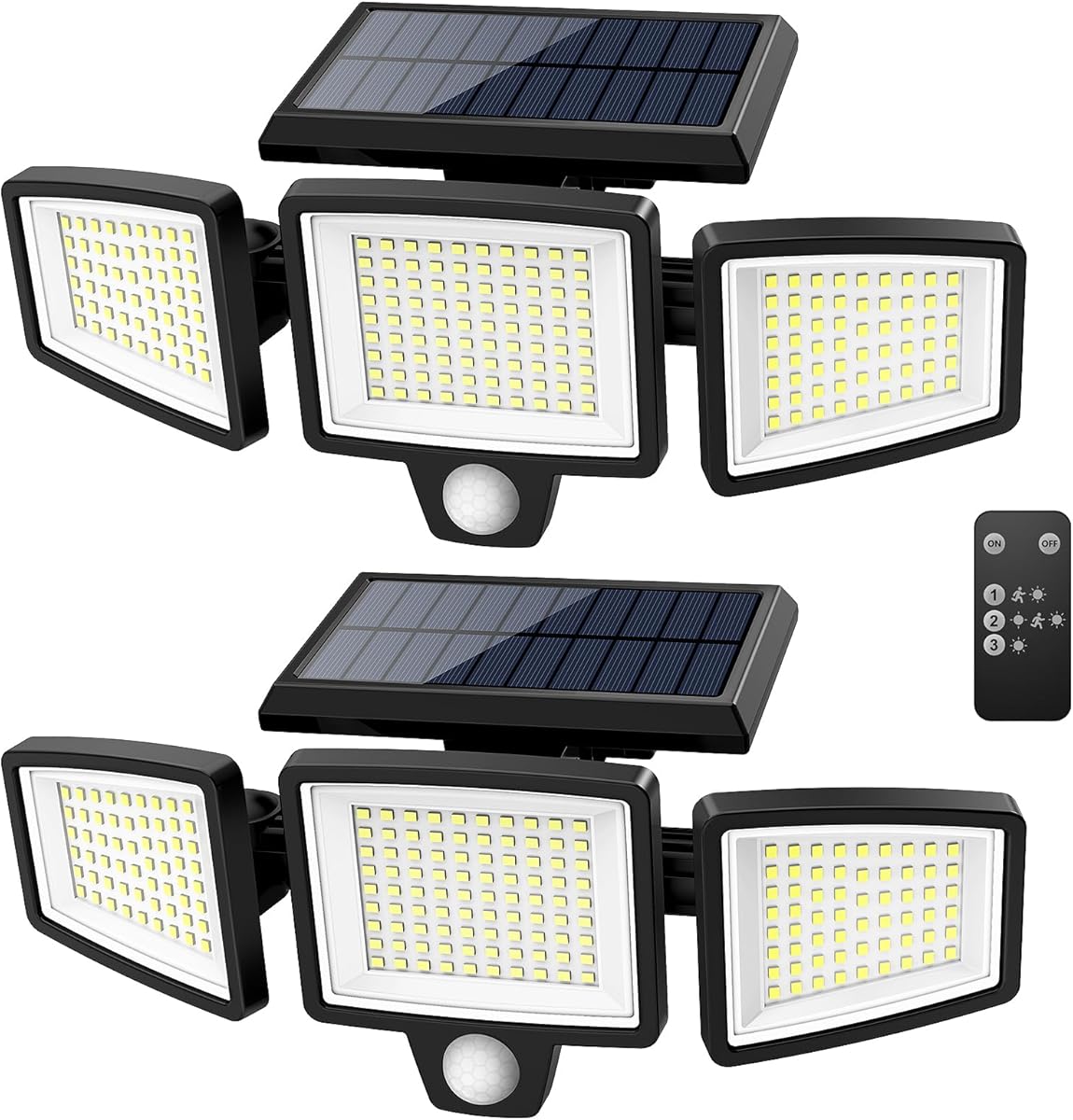
These solar lights combine illumination with motion detection in one unit. They charge during the day and activate high-power LEDs when motion is detected at night, providing security lighting without any wiring requirements.
We may earn a commission when you buy through this link, at no additional cost to you.
The adjustable heads allow precise light direction, and the remote lets you switch between modes easily. With 2500 lumens, they offer bright illumination that deters intruders and lights up dark areas effectively.
Performance depends on sunlight exposure for charging. If placed in shaded areas, battery life may be reduced. However, for accessible outdoor spots, they offer a cost-effective security solution easily.
Recommended for outdoor spaces needing combined lighting and monitoring. The wireless design simplifies installation while providing strong deterrent lighting that responds directly to nearby movement activity.
High-efficiency solar panels ensure fast charging, guaranteeing reliable overnight operation even in moderate sunlight conditions for extended periods.
Remote control allows quick switching between brightness modes, tailoring illumination intensity to specific security needs and energy conservation.
We may earn a commission when you buy through this link, at no additional cost to you.
Selecting the right light sensor depends on your smart home ecosystem, connectivity preferences, and specific security needs. Understanding these factors ensures you choose a model that works seamlessly with your existing setup.
Smart sensors use Wi-Fi, Zigbee, Z-Wave, or proprietary protocols like LoRa or Sidewalk. Wi-Fi is easy but drains batteries faster; Zigbee and Z-Wave require hubs but offer better range and battery efficiency for security devices.
Choose a protocol compatible with your current hub or platform. If you want seamless local control, Zigbee or Z-Wave devices are generally more reliable than Wi-Fi options.
Passive Infrared (PIR) detects motion but misses stationary humans. mmWave radar sensors detect presence even without movement, making them superior for occupancy automation and preventing lights from turning off prematurely.
If you need precise presence detection for lighting or security, prioritize mmWave or dual-technology sensors over basic PIR models.
Compatibility with platforms like Home Assistant, Alexa, or Google Home determines how flexible your automation will be. Check if the sensor supports local APIs or requires cloud services before purchasing.
Verify the sensor works with your preferred smart home platform to avoid limited automation options or reliance on unstable cloud connections.
Battery-powered sensors are flexible but require periodic replacements. Hard-wired or solar-powered models offer uninterrupted operation but need professional installation or specific placement for sunlight.
Evaluate the installation location and battery life before committing. Battery models offer mobility; wired or solar options ensure constant uptime.
The field of view (FOV) determines how much area the sensor covers. A wider angle, like 120 degrees, is better for open rooms; narrower angles suit corridors or entryways.
Match the FOV to your room size to ensure consistent coverage without blind spots or excessive false triggers.
Outdoor sensors must carry an IP rating like IP44 or IP65 to resist water and dust. Indoor sensors generally have lower ratings, so ensure outdoor-rated models are used for exterior installations.
Check the IP rating to ensure durability against rain, dust, and temperature extremes in outdoor or humid environments.
Advanced features like pet-friendly modes, tamper alerts, or ambient light sensors add value. Pet modes prevent false alerts; ambient sensors ensure lights only activate when it gets dark.
Prioritize models with features that directly address your security needs, like pet detection or ambient light control, to reduce unnecessary triggers.
Mounting options vary from adhesive, magnetic, to wall drilling. Easy installation is crucial for renters, while permanent installations may require hardwired power for maximum reliability.
Choose mounting options that suit your home structure and installation capabilities to ensure the sensor stays secure and functional.
Install the sensor at a height of 6 to 8 feet to maximize detection range while avoiding false triggers from pets. Ensure the lens faces away from direct sunlight or heat sources that could confuse the sensor.
Adjust sensitivity and delay settings based on room activity. Higher sensitivity works well for small rooms; lower settings reduce false alarms caused by pets or moving curtains in high-traffic areas.
Maintain the sensor by regularly cleaning the lens with a soft cloth to remove dust and debris. Check battery levels via your smart app and replace batteries as needed to prevent automation failures.
A light sensor detects ambient light levels to automate lighting or trigger security alerts. When combined with motion detection, it ensures lights only turn on when it is dark and motion is detected, improving energy efficiency and home security.
Wi-Fi sensors often work without a hub but drain batteries faster. Zigbee or Z-Wave sensors require a hub to connect to your smart home system. Check the product details to confirm specific connectivity requirements.
Many sensors offer pet-friendly modes that ignore smaller animals under a certain weight. Positioning the sensor higher or adjusting the sensitivity settings can also reduce false triggers from moving pets effectively.
Battery-powered sensors function during power outages if connected to a hub with backup power. Wi-Fi dependent sensors may fail if the router loses power, so consider battery-backed hubs for continuous operation.
Yes, outdoor light sensors must have an IP rating like IP44 or IP65 to withstand rain and dust. Always verify the IP rating before installing a sensor in an exterior location to ensure durability.
Yes, most modern sensors integrate with smart bulbs via platforms like Home Assistant, Alexa, or Google Home. This integration allows automatic lighting adjustments based on motion and ambient light conditions seamlessly.
Battery life typically ranges from six months to two years depending on usage and technology. Low-power protocols like Zigbee or LoRa extend battery life significantly compared to standard Wi-Fi models.
Our top picks like the Zigbee Motion Sensor and Akamatis Litos v3 offer reliable automation and presence detection. These models stand out for their advanced features and seamless integration with popular smart home platforms effectively.
Prioritize connectivity and integration capabilities when choosing a sensor. Whether you prefer local control or cloud-based features, ensure the sensor matches your existing smart home infrastructure for optimal performance.
Remember to verify current availability and details before purchasing since models may vary. By selecting the right light sensor, you can create a secure, automated home environment tailored to your specific needs.