
Sky-Watcher Heritage 130mm
4.5Editor score
Collapsible tube design
Fully assembled out of box
Includes two eyepieces
Dobsonian telescopes offer an unmatched combination of large aperture and simplicity for amateur astronomers. Their altazimuth mounts make them easy to point and track objects across the night sky without complex setup procedures.
We evaluated ten leading models based on optical quality, build stability, portability, and user feedback. Our analysis includes tabletop options for beginners and large aperture designs for deep-sky enthusiasts seeking detailed views.
Each selection highlights specific strengths like app integration, collapsible tubes, or traditional designs. Prices and availability can change frequently, so verify current details before making your final purchasing decision online.
4.5Editor score

4.4Editor score

4.3Editor score
As an Amazon Associate we earn from qualifying purchases.
This table provides a quick side-by-side overview of the key specifications and features for all ten selected models to help you compare them efficiently.




The Sky-Watcher Heritage 150 stands out as a remarkable tabletop telescope that delivers impressive views for its compact size. With a rating of 4.2 stars from users, it proves to be a reliable choice for beginners and casual observers alike.
We may earn a commission when you buy through this link, at no additional cost to you.
Its 150mm aperture provides excellent light gathering power, allowing you to see faint deep-sky objects like the Orion Nebula with clarity. The fast f/5 focal ratio makes it versatile for both wide-field views and detailed planetary observation.
One unique feature is the collapsible tube design, which collapses down for easy transport while maintaining collimation settings. This means you do not need to re-align the optics after moving the telescope, saving significant setup time.
This telescope is ideal for families or individuals with limited space who still want serious observing capabilities. Its portability and ease of use make it a top recommendation for anyone starting their astronomy journey.
The collapsible tube allows for easy transport without compromising optical alignment or requiring frequent re-collimation adjustments before each session.
Rubber feet on the base minimize vibration and increase stability, ensuring smooth viewing even on uneven surfaces like grass or dirt.
We may earn a commission when you buy through this link, at no additional cost to you.
The Celestron StarSense Explorer 10" redefines how beginners approach astronomy by integrating smartphone technology directly into the viewing process. Its 4.4 rating reflects high user satisfaction with its intuitive alignment system and clear optical performance.
We may earn a commission when you buy through this link, at no additional cost to you.
Using patented StarSense technology, the app analyzes star patterns overhead to pinpoint the telescope's position accurately. This eliminates the frustration of traditional star alignment, allowing you to focus immediately on finding interesting celestial targets.
The 10-inch reflector delivers bright and vivid views of planets and deep-sky objects. Whether you are looking at Saturn's rings or the Andromeda Galaxy, the high-reflectivity XLT coatings ensure maximum light transmission and contrast.
This model is perfect for those who want to skip the learning curve of celestial navigation. The on-screen arrows guide you to targets efficiently, making it an excellent gift for tech-savvy families and new stargazers.
The app turns your phone into a celestial navigation system, analyzing star patterns to align the telescope in minutes without prior experience.
The 10-inch aperture and XLT coatings provide sharp views of both solar system planets and distant galaxies in dark sky conditions.
We may earn a commission when you buy through this link, at no additional cost to you.
The Celestron StarSense Explorer 114AZ brings smart alignment features to an entry-level tabletop telescope. With a rating of 4.4 stars, it offers an accessible entry point into astronomy without sacrificing the ease of use provided by modern apps.
We may earn a commission when you buy through this link, at no additional cost to you.
Its 114mm Newtonian reflector is capable of delivering impressive views of the Moon and planets like Jupiter. The included StarSense app simplifies target location, ensuring you spend more time looking and less time searching for objects.
As a tabletop design, it is easy to move and store, making it suitable for balconies or small backyards. The manual altazimuth base provides smooth motion, allowing you to track objects comfortably once aligned.
For budget-conscious buyers who still want technology assistance, this model is an excellent choice. It balances performance, convenience, and price effectively, making it a top contender for first-time telescope owners.
This telescope combines high-quality optics with affordable app-based guidance, providing a premium user experience at a lower price point.
The lightweight tabletop form factor ensures you can set up quickly and move the scope easily between viewing locations.
We may earn a commission when you buy through this link, at no additional cost to you.
The Sky-Watcher Heritage 130mm is widely regarded as one of the best budget options for aspiring astronomers. Boasting a 4.5 star rating, it offers a fraction of the cost of larger telescopes while still delivering breathtaking views of the night sky.
We may earn a commission when you buy through this link, at no additional cost to you.
Its all-in-one compact design combines the base and optical tube into a single tabletop package. This simplicity means no assembly is required, so you can take it straight out of the box and start observing immediately.
The 130mm aperture provides over five inches of light-gathering power, sufficient for observing major planets and star clusters. It includes two eyepieces and a finderscope, giving you immediate versatility for different viewing scenarios.
This telescope is perfect for beginners who want quality optics without a complex setup. Its portability and ease of use make it an ideal choice for casual observers or families introducing children to astronomy.
Fully assembled right out of the box, this model saves time and hassle, allowing you to begin observing immediately without tools.
With over 5 inches of aperture, you get clear views of lunar craters and planetary details at a very affordable price point.
We may earn a commission when you buy through this link, at no additional cost to you.
The Sky-Watcher Classic 200 represents a traditional approach to Dobsonian telescopes with its solid-tube design and large aperture. With a rating of 3.9 stars, it appeals to those who value optical power and a classic viewing experience.
We may earn a commission when you buy through this link, at no additional cost to you.
Its eight-inch aperture collects significantly more light than smaller models, revealing faint galaxies and nebulae that are invisible to smaller scopes. The parabolic primary mirror ensures sharp images across the field of view.
Patented tension control handles allow for accurate movement without the need for perfect balance. This feature simplifies the handling of the optical tube, making it easier to point and track objects manually.
Ideal for enthusiasts ready to step up from smaller instruments, this telescope provides a robust platform for serious observing. Its complete accessory kit and sturdy build make it a reliable workhorse for backyard astronomy.
These patented handles ensure accurate movement without requiring perfect balance, simplifying the manual tracking process for the user.
Fully multi-coated borosilicate mirrors deliver exceptional views with high reflectivity, maximizing light transmission for better contrast.
We may earn a commission when you buy through this link, at no additional cost to you.
The Celestron StarSense Explorer LT 114AZ combines smartphone guidance with a practical altazimuth mount for enhanced usability. Its 4.1 rating indicates reliable performance for users looking to combine traditional viewing with modern assistance.
We may earn a commission when you buy through this link, at no additional cost to you.
This model features an altitude slow motion adjustment with a sliding rod, allowing for smoother tracking of celestial objects. The StarSense app helps you locate targets quickly, reducing the frustration of manual searching.
While it shares similarities with the tabletop version, this mount offers a different setup that might suit different viewing heights. The 114mm reflector provides clear views of bright deep-sky objects and planets.
For those who want a bit more stability than a pure tabletop model, this is a solid choice. It balances ease of use with optical capability, making it a strong contender for intermediate beginners.
The altitude slow motion adjustment helps you track moving objects smoothly without jarring movements or losing your target.
The app displays a curated list of targets based on time and location, guiding you to the best viewing opportunities instantly.
We may earn a commission when you buy through this link, at no additional cost to you.
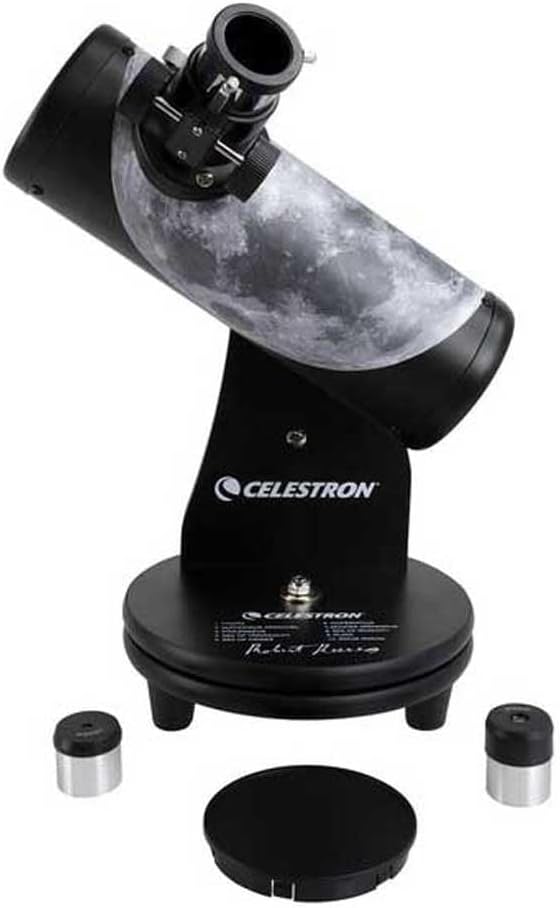
The Celestron FirstScope Signature Series is designed specifically for easy viewing of the Moon and bright planets. With a rating of 4.3 stars, it is praised for its simplicity and ability to engage younger or new astronomers effectively.
We may earn a commission when you buy through this link, at no additional cost to you.
Its tabletop design means you can place it on any flat surface without needing a full-sized stand. This makes it incredibly portable and ideal for casual viewing sessions in the backyard or on a balcony.
While it may not offer the deep-sky capabilities of larger models, it excels at delivering sharp and detailed views of lunar craters. The optics are optimized for clarity at low to medium magnifications.
This telescope is an excellent starting point for families with children. Its durability and ease of use ensure that young observers can enjoy the night sky without needing complex adjustments or tools.
The tabletop form factor allows for placement on any flat surface, making it easy to carry and set up anywhere.
Optimized for lunar observation, it provides clear views of craters and surface features that captivate beginners.
We may earn a commission when you buy through this link, at no additional cost to you.
The Sky-Watcher Flextube 200 solves the portability challenge of large-aperture telescopes with its unique strut design. With a rating of 4.0 stars, it allows users to transport an eight-inch scope easily without sacrificing optical performance.
We may earn a commission when you buy through this link, at no additional cost to you.
The collapsible tube design allows for the optical tube to collapse significantly, reducing the overall length for transport. Despite this flexibility, it maintains collimation well, ensuring consistent optical quality every time you use it.
With fully multi-coated mirrors and a 2-inch Crayford-style focuser, this telescope provides high-quality viewing experiences. The included accessories like wide-angle eyepieces add immediate value to the purchase.
This model is ideal for observers who want a larger instrument but do not have a permanent observatory setup. Its balance of size, power, and portability makes it a compelling choice for advanced amateurs.
Unique strut design allows for optical tube collapse without losing collimation, reducing the size for transport significantly.
The 2-inch Crayford-style focuser provides smooth and precise focusing, essential for sharp images at higher magnifications.
We may earn a commission when you buy through this link, at no additional cost to you.
The Sky-Watcher Virtuoso GTI 150P combines tabletop convenience with automated GoTo capabilities via Wi-Fi. Its 4.3 rating reflects the success of its dual encoder system that retains alignment while allowing manual control.
We may earn a commission when you buy through this link, at no additional cost to you.
With built-in Wi-Fi and the SynScan Pro app, you can control the telescope directly from your smartphone. This technology allows for precise movement and tracking without needing a dedicated hand controller.
The 150mm aperture and fast f/5 optics provide bright views of galaxies and nebulae. Freedom Find technology ensures that even if you manually move the scope, it knows where it is pointing.
For tech-forward observers who want automation without a full-sized mount, this is an excellent solution. It bridges the gap between manual and computerized telescopes effectively.
Built-in Wi-Fi allows full control via app, removing the need for physical hand controllers and cables.
Patented dual encoders allow manual control while retaining alignment, giving you freedom to explore anywhere.
We may earn a commission when you buy through this link, at no additional cost to you.
The Celestron NexStar 8SE is a fully computerized telescope that simplifies observing through automated tracking and alignment. With a 4.3 rating, it is a favorite among those ready to move beyond manual scopes to precision observation.
We may earn a commission when you buy through this link, at no additional cost to you.
The eight-inch Schmidt-Cassegrain optics gather significant light, revealing fine details on Jupiter and distant galaxies. The fully automated GoTo mount slews to targets automatically using the NexStar+ hand control.
SkyAlign technology lets you align the mount quickly by centering any three bright stars or planets. This makes setup fast even for those who are not familiar with specific constellations.
While more expensive and complex than simple Dobsonians, its precision and automation make it worth the investment for serious hobbyists. It offers a premium experience for those who value ease of use and accuracy.
The computerized mount tracks objects automatically, keeping them in the eyepiece without manual adjustment.
Align quickly by centering three stars, even without knowing their names, getting you observing in minutes.
We may earn a commission when you buy through this link, at no additional cost to you.
Choosing the right Dobsonian telescope involves balancing aperture, portability, and budget to find a model that fits your lifestyle and observational goals.
Aperture refers to the diameter of the primary mirror and determines how much light the telescope can gather. Larger apertures allow you to see fainter objects like distant galaxies and nebulae with greater detail. For beginners, a range between 130mm and 150mm offers a good balance of power and portability, while experienced observers often prefer eight-inch models for deep-sky viewing.
Prioritize the largest aperture you can comfortably transport and set up. While bigger is generally better for visibility, practicality matters for regular use.
The mount must be sturdy enough to support the optical tube without wobbling or shaking. A stable base ensures that your view remains steady even at higher magnifications. Traditional Dobsonians use rockers boxes made of wood or plastic, which are generally robust and reliable.
Check for features like tension control handles or smooth bearings that improve movement precision. A wobbly mount can ruin the viewing experience regardless of optical quality.
Portability is a major consideration for telescopes you plan to take to dark sky sites. Look for collapsible tube designs or tabletop models if space is limited. Some models disassemble into separate components, making them easier to fit into car trunks.
Consider the total weight of the telescope when it is fully assembled. If you need to walk a distance to your viewing spot, a lighter model will be much more manageable for repeated use.
Ease of use encompasses setup time and the learning curve required to find objects. Some modern models include smartphone apps or automated GoTo systems that simplify alignment. Traditional models rely on you finding stars manually, which can be educational but challenging.
If you want instant results, choose a model with app-guided features or automation. For those who enjoy learning the sky, a manual model provides a more rewarding experience over time.
The quality of the primary mirror significantly impacts image clarity and contrast. Look for telescopes that use parabolic mirrors rather than spherical ones for better image correction. Coatings like XLT or RAQ improve light transmission and reduce glare.
Inspect the focal ratio as well. Faster optics like f/5 allow for wider fields of view, which is great for deep-sky objects. Slower optics offer higher magnification potential for planetary details.
Check what eyepieces, finderscopes, and other tools come in the box. Many models include two eyepieces to cover different magnification ranges immediately. A good finderscope is essential for locating targets accurately.
Ensure the included accessories match the telescope's capabilities. Poor quality eyepieces can undermine even the best optics, so upgrade if needed over time.
Your budget will dictate which features you can access. Tabletop models are generally cheaper but have smaller apertures. Large aperture models cost more but offer superior views. Set a realistic budget that includes any necessary accessories.
Remember that price does not always equate to the best experience for your specific needs. Sometimes a mid-range model offers better portability or support than the most expensive option.
Reputable brands offer warranties that protect against defects in materials and workmanship. A two-year warranty is standard for many high-quality manufacturers. Customer support can be vital if you encounter issues during setup or use.
Always check the terms of the warranty before purchasing. Reliable support ensures you can resolve problems quickly without significant expense or downtime.
Set up your telescope on a flat and stable surface to prevent wobbling or accidental falls. Allow the optics to acclimatize to the outside temperature for about twenty minutes to ensure the clearest possible views by reducing internal air currents.
Use the included eyepieces to start with low magnification to find your target. Once you have centered the object, you can switch to a higher magnification eyepiece for detailed observation. Always ensure the finder scope is aligned with the main telescope before dark.
Protect your telescope from dust and moisture by storing it in a dry place when not in use. Clean the lenses only with approved tools and solutions to avoid scratches or damage to the reflective surfaces. Regular maintenance keeps your equipment functioning perfectly for years.
Dobsonian telescopes are known for their simple altazimuth mounts that are easy to move and point. Unlike equatorial mounts that require polar alignment, these are designed for quick setup and intuitive tracking across the sky.
Yes, they are excellent for beginners because they are easy to set up and use without complex alignment. The simple design allows new users to focus on viewing celestial objects immediately without getting bogged down by technical adjustments.
You can use a Dobsonian from the city, though light pollution may limit deep-sky views. Planets and the Moon will still look great regardless of location, so they remain versatile options even for urban astronomers.
Traditional models do not track automatically and require manual adjustment to follow stars. However, some modern versions include GoTo systems or app integration that automate this process for easier viewing.
Clean the mirror gently with warm water and a few drops of mild dish soap using a soft sponge. Rinse with distilled water and let it dry naturally in a dust-free environment to avoid scratches on the coating.
You do not typically need a tripod because the base of the telescope is self-supporting. However, using a high magnification eyepiece may benefit from a stable surface to avoid shaking or vibrations.
This guide reviewed ten top models ranging from budget-friendly tabletops to advanced computerized systems. Each option offers unique strengths tailored to different levels of experience and observing preferences.
Prioritize aperture size and portability based on your specific needs and available space. Consider whether you prefer manual exploration or automated assistance when narrowing down your choices.
Prices and availability are subject to change, so verify current stock and pricing before purchasing. We hope this overview helps you find the perfect telescope to explore the night sky.