
FNIRSI DSO152
4.4Editor score
200kHz bandwidth
2.5MS/s sampling
Portable handheld design
Finding a reliable cheap oscilloscope can transform how you diagnose electronic circuits. Whether you are a student, hobbyist, or professional, having the right tool ensures accurate signal analysis. Budget models now offer impressive features without breaking the bank, making advanced diagnostics accessible to everyone looking to build or repair devices.
We have carefully evaluated ten top-rated models to create this comprehensive list. Each product was selected based on its specifications, user ratings, and versatility in real-world applications. Our comparison covers bandwidth, sampling rates, and additional functions like built-in multimeters or signal generators to ensure you get the most value.
Every pick in this guide highlights unique strengths tailored to different needs. Some excel in portability, while others offer advanced features like touchscreen interfaces or FFT analysis. Please note that prices fluctuate frequently, so checking the current listings is recommended before making a final purchase decision for your workspace.
4.4Editor score

4.3Editor score

4.1Editor score
As an Amazon Associate we earn from qualifying purchases.
This table provides a side-by-side comparison of all ten selected oscilloscopes. Reviewing these core specifications side by side helps identify which model offers the necessary bandwidth and features for your specific diagnostic or educational requirements without overspending.



The FNIRSI DSO152 stands out as an incredible value for hobbyists needing basic signal analysis. With a 200kHz bandwidth and 2.5MS/s sampling rate, it handles common audio and low-frequency digital signals effectively. Its compact design makes it easy to carry to fieldwork or classroom demonstrations.
We may earn a commission when you buy through this link, at no additional cost to you.
Users appreciate the straightforward interface that allows for quick setup without complex calibration. The one-key AUTO function simplifies waveform capture, making it accessible for beginners. Additionally, the Type-C interface supports both charging and data transfer, ensuring you can save your work efficiently.
While the bandwidth limits high-frequency analysis, it is sufficient for most educational and maintenance tasks. The 10x probe measures up to 800VPP, providing safety for common household circuits. This trade-off ensures the device remains lightweight and affordable for general use.
This oscilloscope is ideal for students and DIY enthusiasts who need a reliable tool without a high price tag. Its durability and ease of use make it a top recommendation for entry-level electronic troubleshooting and learning.
The lightweight chassis fits easily in a tool bag, allowing technicians to diagnose issues on-site without carrying heavy equipment.
The built-in 1000mAh battery provides approximately four hours of continuous use, keeping you working longer between charges.
We may earn a commission when you buy through this link, at no additional cost to you.
The FNIRSI 2C53T combines an oscilloscope, multimeter, and signal generator into a single unit, offering immense versatility. Its 50MHz bandwidth and 250MSa/s sampling rate provide detailed views of complex waveforms. The upgraded features like persistence mode and cursor measurement enhance its analytical capabilities significantly.
We may earn a commission when you buy through this link, at no additional cost to you.
Built-in FPGA architecture ensures stable performance during long testing sessions. The device supports waveform storage and export, allowing engineers to document findings for reports. High voltage protection modules add safety when measuring industrial or automotive signals exceeding standard limits.
Although the screen brightness could be higher for outdoor use, the 2.8 inch display offers clear visibility indoors. The 3000mAh battery supports up to six hours of standby, ensuring reliability during extended fieldwork without frequent recharging interruptions.
This model is perfect for professionals who need multiple diagnostic tools in a compact form factor. It balances advanced features with ease of use, making it a top choice for both schools and workshops requiring comprehensive testing capabilities.
By integrating a multimeter and signal generator, this device reduces the need for separate tools, streamlining your workbench setup.
Features like XY mode and math operations allow for deeper signal analysis, helping identify phase differences and frequency harmonics.
We may earn a commission when you buy through this link, at no additional cost to you.
The FNIRSI DSO-510 is designed with simplicity in mind, making it an excellent choice for introductory electronics courses. Its 10MHz bandwidth covers most low-frequency signals found in basic circuit labs. The infinite afterglow feature helps visualize signal changes over time effectively.
We may earn a commission when you buy through this link, at no additional cost to you.
Students benefit from the one-key AUTO function which automatically optimizes parameters for clear viewing. The DDS signal generator allows for basic waveform simulation, aiding in testing and calibration exercises. This dual functionality encourages interactive learning without needing separate equipment.
While the bandwidth limits use for RF work, it suffices for audio and digital logic experiments. The 2.8 inch LCD provides adequate resolution for classroom settings. Its portability ensures that instructors can easily move it between different lab stations during lessons.
This device is highly recommended for educational institutions needing reliable yet affordable tools. It empowers learners to explore signal analysis concepts independently while maintaining safety and ease of use in a controlled environment.
The simple interface allows students to focus on circuit concepts rather than struggling with complex menu navigation during experiments.
Infinite afterglow helps track transient events and slow-moving signals that might otherwise be missed on standard digital displays.
We may earn a commission when you buy through this link, at no additional cost to you.
The FNIRSI DPOS350P pushes the boundaries of what a handheld unit can achieve with its 350MHz bandwidth and 1 GSa/s sampling. It includes spectrum and frequency response analysis tools often found in larger benchtop units. The 7 inch touchscreen provides ample workspace for detailed waveform inspection.
We may earn a commission when you buy through this link, at no additional cost to you.
Professional engineers appreciate the digital phosphor capabilities that reveal signal artifacts and intermittent glitches. The 4-in-1 design integrates a signal generator, making it a self-contained lab station. This high-speed sampling ensures accurate capture of fast digital signals without aliasing.
The main drawback is its weight and price compared to basic models, but the feature set justifies the investment. The 8000mAh battery supports long sessions in remote locations. This makes it suitable for field maintenance of industrial machinery where high precision is non-negotiable.
For professionals needing advanced diagnostics without the bulk of a full rack system, this is the premier choice. Its comprehensive analysis tools and robust build quality ensure it meets rigorous industry standards.
The built-in spectrum analyzer allows for EMI checks directly on the device, simplifying noise source identification in the field.
The large capacitive touchscreen offers intuitive gesture controls for zooming and moving waveforms, enhancing measurement efficiency.
We may earn a commission when you buy through this link, at no additional cost to you.
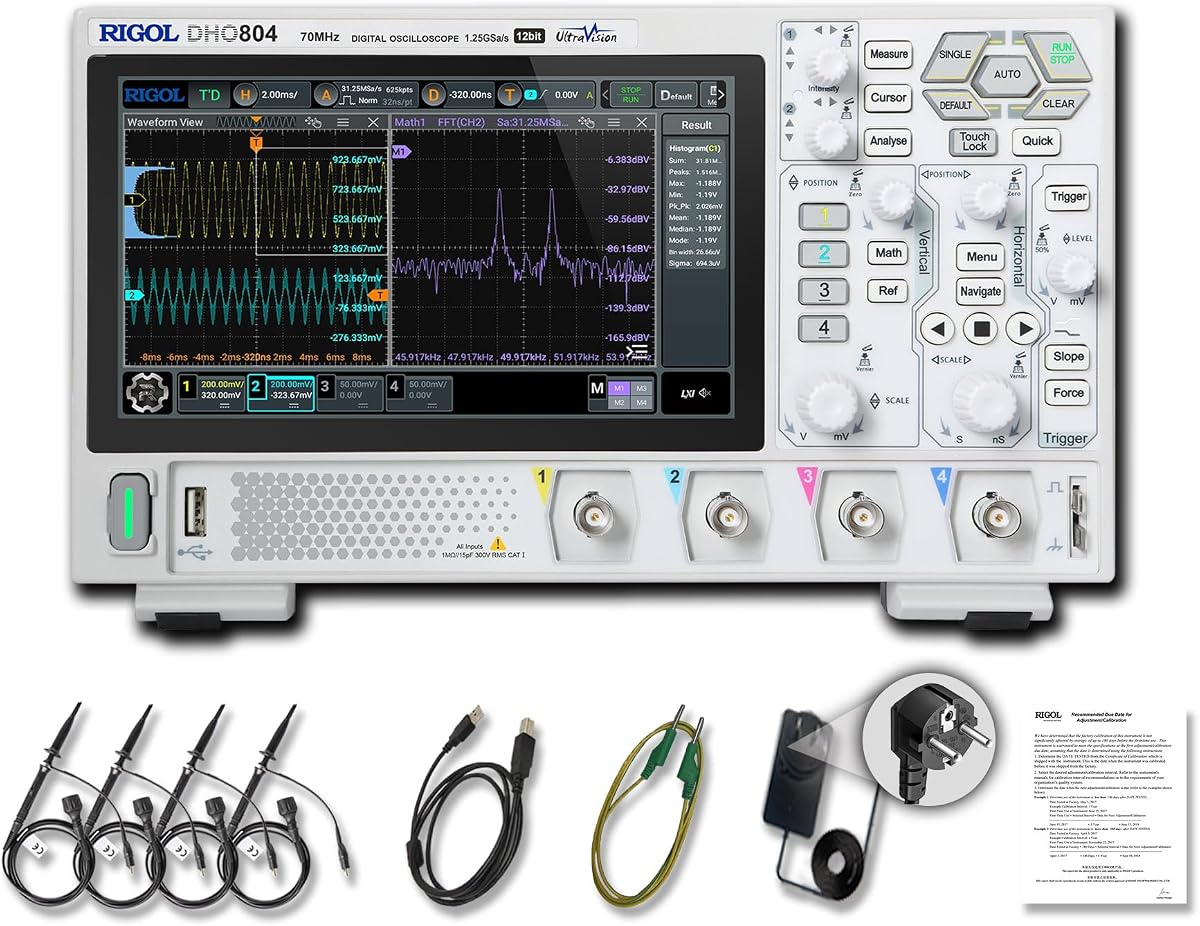
The RIGOL DHO804 sets a benchmark for portable oscilloscopes with its 12-bit vertical resolution and four analog channels. This high resolution allows for clear visualization of small voltage changes that other scopes might miss. It is ideal for checking power supply ripple and noise in modern electronics.
We may earn a commission when you buy through this link, at no additional cost to you.
The UltraAcquire technology captures over a million waveforms per second, ensuring intermittent glitches are not overlooked. Connectivity options like LAN and HDMI allow for remote control and presentation, which is great for teaching or team reviews. Its search and navigation features speed up data analysis significantly.
While the price is higher than entry-level options, the precision it offers is unmatched in its class. The browser web control enables monitoring without touching the device, which is useful for long-term tests. The 7 inch touch screen provides a modern interface for complex measurements.
This unit is best suited for embedded systems engineers who need high fidelity and detailed timing analysis. Its advanced features make it a valuable asset for development teams working on high-performance circuit designs and debugging.
The 12-bit ADC ensures that even minor voltage variations are visible, crucial for analyzing power integrity issues in PCBs.
LXI-C support and web control enable integration into automated test systems without needing specialized programming software.
We may earn a commission when you buy through this link, at no additional cost to you.
The FNIRSI 2C53P stands out with its 4.3 inch IPS touchscreen, offering a modern interface for signal analysis. It features a 50MHz bandwidth and 250MSa/s sampling rate, suitable for a wide range of repair tasks. The touch controls make navigating menus and adjusting cursors much more intuitive than button-based models.
We may earn a commission when you buy through this link, at no additional cost to you.
Engineers can perform FFT spectrum analysis directly on the device to identify harmonic content. The 4000mAh battery provides reliable power for long field jobs. It supports waveform export, allowing for digital record-keeping and further analysis on a PC.
Although it has many features, the interface may take time to master for new users. The multimeter mode is robust, covering voltage, current, and resistance accurately. This makes it a versatile tool for general electronics maintenance and diagnostics.
For users who prefer a touch interface, this model offers excellent value. It combines necessary diagnostic tools into one unit, reducing the need to switch between different devices during troubleshooting sessions.
The capacitive screen allows for pinch-to-zoom gestures, making it easier to examine specific parts of a waveform in detail.
Waveform export features ensure that data can be archived for future reference, maintaining a historical record of repairs.
We may earn a commission when you buy through this link, at no additional cost to you.
The FNIRSI 1013D Plus offers a massive 7 inch touchscreen with 800×480 resolution for clear waveform viewing. Its 100MHz bandwidth and 1GSa/s sampling rate allow for detailed observation of fast signals. The large display makes it easy to read measurements without squinting or using external magnification tools.
We may earn a commission when you buy through this link, at no additional cost to you.
Gesture operations simplify zooming and scrolling, making complex signal analysis more efficient. With 1GB of storage, you can save thousands of waveforms or screenshots for documentation. This is particularly useful for audit trails or comparing historical data across different devices.
The device is slightly heavier than smaller handheld models, but the trade-off is a superior viewing experience. The high voltage protection ensures safety during automotive or industrial testing. It handles both periodic and aperiodic signals effectively with automatic trigger modes.
This model is ideal for those who prioritize display quality and ease of interaction. It is well-suited for repair shops where clear visibility and quick data retrieval are essential for efficient workflow and accurate diagnostics.
With 1000 sets of waveform data storage, technicians can track device behavior over time without constantly overwriting old files.
The high-contrast screen ensures that waveforms are visible even in bright workshop environments, reducing eye strain during long tasks.
We may earn a commission when you buy through this link, at no additional cost to you.
The FNIRSI 2C23T is a robust choice for basic electronic work, boasting high user ratings for reliability. It offers a 10MHz bandwidth which is sufficient for audio and basic digital logic testing. The integration of a multimeter and signal generator adds versatility to this compact unit.
We may earn a commission when you buy through this link, at no additional cost to you.
Its 3000mAh battery ensures long standby times, allowing for extended periods of use without recharging. The FPGA-based hardware architecture ensures stable waveform capture even in noisy environments. This makes it a trustworthy companion for school labs or home hobby workshops.
While it does not support high-frequency signals, its performance in its range is excellent. The hardware design includes high-voltage protection modules for safety. It supports waveform storage, allowing users to review past measurements for pattern recognition.
This device is perfect for users who need a simple, reliable tool for routine tasks. Its durability and ease of use make it a top recommendation for beginners looking to learn electronics without overwhelming complexity.
The FPGA architecture ensures that signals are captured accurately without digital artifacts, providing clear and trustworthy measurements.
Its small size fits easily in any toolkit, making it ideal for technicians who move frequently between job sites.
We may earn a commission when you buy through this link, at no additional cost to you.
The FNIRSI 2D15P offers a high 500MSa/s sampling rate and 100MHz bandwidth for detailed analysis of complex signals. It integrates a multimeter and signal generator, making it a comprehensive tool for various diagnostic needs. The 4.3 inch touchscreen allows for intuitive control and clear visualization of data.
We may earn a commission when you buy through this link, at no additional cost to you.
With a 5000mAh battery, it supports extended field use without interruptions. The device includes cooling fans to maintain stability during high load operations. This ensures that accuracy is maintained even during long testing sessions in warm environments.
While the interface is complex, once mastered, it provides powerful analysis capabilities. The waveform export feature allows for detailed reporting and sharing with teams. Its ability to capture fine waveforms is useful for troubleshooting subtle electronic faults.
This model is best suited for engineers who need robust performance in a portable form. It balances cost and capability, making it an excellent choice for professional repair and development work.
The 500MSa/s sampling rate ensures that fast edges are captured accurately, preventing signal distortion in measurements.
Active cooling keeps the internal components at optimal temperatures, ensuring consistent performance during demanding analysis tasks.
We may earn a commission when you buy through this link, at no additional cost to you.
This 3-in-1 handheld oscilloscope is tailored for automotive applications with dual-channel capabilities and 50MHz bandwidth. It features an automatic recognition function that quickly identifies waveforms, saving time during diagnostics. The integrated multimeter supports 25000 counts for precise electrical measurements.
We may earn a commission when you buy through this link, at no additional cost to you.
The device supports data transfer via Type-C for seamless logging of diagnostic results. It has high-speed modes to capture fast signals from modern vehicle electronics. This ensures that intermittent faults are not missed during routine maintenance checks or complex troubleshooting.
The build quality is solid, designed to withstand the rigors of a workshop environment. It requires reading the manual due to its extensive feature set, but this pays off in precision. The signal generator mode allows for simulating test signals to verify circuit responses.
For automotive professionals, this unit is a cost-effective alternative to expensive benchtop tools. Its comprehensive features and durability make it an essential addition to any technician's toolkit for modern vehicle repair and diagnosis.
The auto recognition feature quickly identifies waveforms like pulse or noise, speeding up the diagnosis process significantly.
Type-C data transfer ensures that test results can be easily saved and shared with clients or management teams.
We may earn a commission when you buy through this link, at no additional cost to you.
Selecting the right oscilloscope requires understanding your specific needs and technical requirements. This section covers key factors to consider to ensure you find a model that offers the best performance for your budget.
Bandwidth determines the highest frequency signal the oscilloscope can accurately display. For audio and basic electronics, 20MHz to 50MHz is usually sufficient. However, if you are working with RF or high-speed digital signals, look for models with 100MHz or higher to avoid signal distortion.
Always choose a bandwidth at least five times higher than your highest signal frequency for accurate representation.
Sampling rate refers to how many samples of the signal are taken per second. A higher sampling rate ensures that fast edges and details are captured without aliasing. For general purposes, rates of 250MSa/s or higher provide a good balance of performance and affordability.
Ensure the sampling rate is at least 2.5 times the bandwidth for the Nyquist criterion to maintain signal integrity.
Two-channel scopes are standard for comparing input and output signals, but four-channel units allow simultaneous monitoring of multiple lines. Consider whether you need to monitor multiple power rails or signal paths at once. Dual-channel is often sufficient for repair work, while four channels are better for complex debugging.
Select a channel count that matches your typical testing scenarios to avoid overspending or under-specifying.
Modern oscilloscopes often feature LCD or IPS screens with varying resolutions. Touchscreens offer intuitive control, while button-based models may be more durable. A larger screen size helps in visualizing detailed waveforms comfortably in bright environments. Consider the screen brightness and resolution for your workspace lighting.
Opt for a screen that is large and bright enough to see clear waveforms without eye strain.
Connectivity options like USB, HDMI, or Ethernet allow for data export and remote control. These features are essential for saving waveforms for reports or presenting to teams. Type-C ports are becoming standard for charging and data, providing versatility in modern setups. Ensure the device supports the protocols you need for data transfer.
Check for data export capabilities to ensure you can save and analyze measurements digitally.
Since handheld models are used in various locations, battery life is critical. Look for units with at least four to six hours of continuous use on a single charge. High-capacity lithium batteries ensure you can work through long shifts without needing frequent recharging interruptions. Fast charging is a bonus feature to minimize downtime.
Prioritize models with large battery capacities if you plan to work away from power sources often.
Many affordable models now include built-in multimeters, signal generators, or FFT spectrum analysis. These features reduce the need for multiple tools and increase versatility. For example, a built-in generator is useful for testing circuits without external equipment. Evaluate which extra functions are essential for your workflow.
Consider 3-in-1 or 4-in-1 models to save space and money on separate diagnostic instruments.
Safety should be a priority when measuring voltages that exceed safe limits. Look for devices with high-voltage protection modules that can handle spikes. Probes should also be rated appropriately for the voltages you intend to measure. Always check the maximum voltage rating of the scope and probe before use.
Ensure the device meets safety standards and has protective features to prevent damage during high-voltage testing.
Start by connecting the probe to the input channel and ensuring the ground clip is attached to a reference point on your circuit. Use the AUTO button to let the oscilloscope automatically adjust the time base and voltage scale for a clear waveform display. This simplifies the initial setup process significantly.
To measure frequency or amplitude, utilize the cursor functions or automatic measurement menus provided by the device. If you need to save a waveform, access the storage menu to export the image or data to a USB drive or PC. Regularly calibrate your probe to maintain accuracy across different tests.
Store your oscilloscope in a dry, cool place to prevent damage to sensitive electronics. Avoid dropping the device or exposing it to excessive dust and moisture. Keep the lens and screen clean with a soft cloth to ensure visibility. Proper maintenance will extend the lifespan and reliability of your unit.
For most basic electronics such as audio and logic circuits, a bandwidth of 20MHz to 50MHz is sufficient. This range allows you to view common signals without needing expensive high-frequency capabilities.
Yes, modern handheld models offer high accuracy and stability suitable for professional troubleshooting. Features like 12-bit resolution and high sampling rates ensure precise measurements for serious repair tasks.
Most units allow saving waveforms via USB or Type-C ports. Check the storage menu to export images or data files, which can then be viewed on a computer or printed for reports.
Absolutely, an oscilloscope is primarily used to view existing signals. A signal generator is optional for testing circuit responses but not required for standard diagnosis and measurement tasks.
Always check the voltage ratings of the oscilloscope and probes before measuring. Ensure the ground clip is connected correctly to avoid short circuits, and use probes rated for the voltage levels you are testing.
Calibration is recommended annually or after rough handling to ensure accuracy. Use the built-in calibration signal to check your probes, though most modern devices maintain stable performance without frequent manual adjustments.
Our top picks highlight the FNIRSI DSO152 for budget users, the 2C53T for versatility, and the DPOS350P for premium features. Each model offers distinct advantages tailored to different user needs and budgets. Choosing the right one depends on your specific measurement requirements and frequency needs.
Prioritize bandwidth and sampling rates that match your typical projects to ensure reliable performance. Additional features like multimeters or touchscreen interfaces can significantly enhance workflow efficiency and ease of use. Investing in a device with robust safety features protects both your equipment and yourself.
Prices for these devices fluctuate regularly due to market demand and availability. Always check current listings and compare deals before purchasing to get the best value. With the right tool, you can tackle complex electronic diagnostics confidently and efficiently.