
M-AUDIO Keystation 88 MK3
4.5Editor score
Semi-weighted velocity-sensitive keys
Plug and play USB connectivity
Includes music production software bundle
This guide compares the top 88 key weighted MIDI controllers for production, highlighting key feel, integration, and features to help you choose.
Finding the right keyboard for music production can transform your workflow. An 88 key weighted MIDI controller offers the full range of a piano with expressive control. It brings a realistic playing experience to virtual instruments and software synthesizers.
We evaluated these models based on key action, connectivity, and software integration. Each option provides unique benefits for producers, composers, and performers. Our comparison focuses on build quality, responsiveness, and value for different needs.
Each pick includes detailed insights into performance and compatibility. You will see how they handle dynamics and customization. Keep in mind that availability and pricing may shift over time as new models release.
4.5Editor score

4.6Editor score

4.3Editor score
This side-by-side comparison highlights the core specifications and unique attributes of each top-rated controller to help you make an informed decision for your studio setup.



The Novation Launchkey 88 MK3 stands out as a top choice for producers who need deep software integration. It rates highly for its ability to work effortlessly with leading digital audio workstations. This controller offers premium semi-weighted keys that feel responsive and natural during long sessions.
We may earn a commission when you buy through this link, at no additional cost to you.
Its standout feature is the seamless DAW integration which allows you to access critical controls instantly. The built-in arpeggiator with Strum Mode adds rhythmic depth to your melodies. Creative scale and chord modes make it easy to experiment with new ideas without needing music theory knowledge.
While the keys are semi-weighted rather than fully weighted, they still provide a solid playing experience. Some users may find the customization options slightly limited compared to high-end rivals. However, these trade-offs are acceptable given the price point and overall performance quality.
This controller is ideal for home studio producers and composers who value workflow efficiency. If you need a controller that gets you recording quickly without complex setup, this is a strong recommendation. It balances features and usability exceptionally well for modern production needs.
Deep integration with major DAWs means you can mix and edit tracks without leaving your keyboard.
Scale and chord modes unlock new melodic possibilities, helping you overcome writer's block quickly.
We may earn a commission when you buy through this link, at no additional cost to you.
The M-AUDIO Keystation 88 MK3 is an essential choice for those entering music production on a budget. It offers 88 full-size velocity-sensitive semi-weighted keys at a very accessible price. Its plug-and-play connectivity makes it incredibly easy to start using with your Mac or PC immediately.
We may earn a commission when you buy through this link, at no additional cost to you.
This controller includes basic but essential controls like a volume fader and transport buttons. It is slim enough to fit on almost any desk without taking up too much space. The included software bundle adds significant value by giving you tools to start creating music right away.
As a budget option, it lacks the advanced customization found in higher-end models. The build feels mostly plastic and might not withstand heavy touring conditions. These limitations are reasonable considering how affordable it is for learning and casual recording.
If you are a student or hobbyist looking for an entry-level full-size controller, this is a top pick. It provides the fundamental tools needed to learn MIDI production without breaking the bank. It is a solid foundation for building your home studio setup over time.
No drivers are required, allowing you to start recording music within minutes of connecting the device.
Included plugins and DAW Lite versions help you get started without needing additional purchases.
We may earn a commission when you buy through this link, at no additional cost to you.
The Arturia KeyLab 88 mk3 offers a premium experience with fully weighted hammer-action keys that mimic an acoustic piano. Its robust build quality ensures it can handle professional studio demands over years. The controller integrates deeply with modern software and features a sleek updated design.
We may earn a commission when you buy through this link, at no additional cost to you.
Key strengths include the high-resolution display for real-time feedback on parameters. The 12 pressure-sensitive pads offer precise control for drum programming and clip launching. USB-C power makes it easier to integrate into modern laptop-based setups without bulky power adapters.
The main trade-off is the higher price compared to entry-level options. It is also quite heavy which might be difficult for frequent travelers. However, the improved feel and control justify the investment for serious producers who need reliability.
This controller is best suited for professionals and enthusiasts who demand the best feel and features. If you are building a high-end home studio, this model provides the tactile feedback needed for expressive performances. It stands out as a top-tier choice for serious music creation.
The weighted hammer-action keys provide a realistic touch that helps translate piano skills to digital production.
The onboard screen shows parameter changes clearly, reducing the need to stare at your computer monitor.
We may earn a commission when you buy through this link, at no additional cost to you.
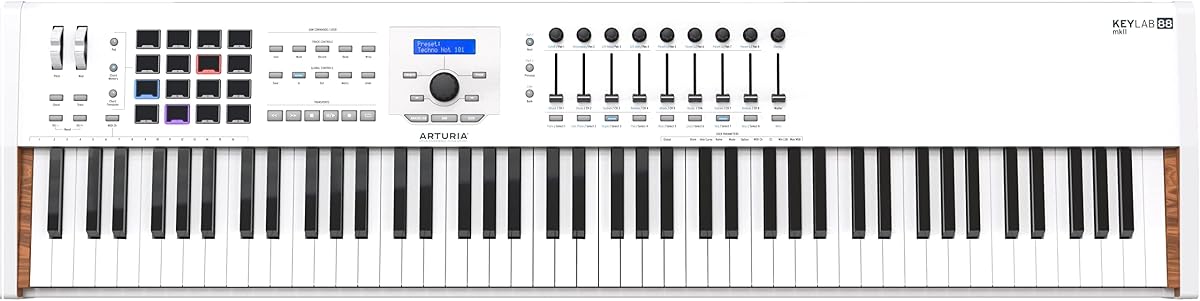
The white version of the Arturia KeyLab 88 mk3 offers the same premium features as the black model. It features fully weighted hammer-action keys and a sturdy metal build for durability. The unique color choice helps it stand out as a centerpiece in your studio or stage setup.
We may earn a commission when you buy through this link, at no additional cost to you.
Its key strengths mirror the black model with excellent control options and visual feedback. The 12 pressure-sensitive pads allow for versatile drum programming. USB-C power ensures compatibility with modern devices without needing extra power bricks.
While the aesthetic is appealing, the white finish may show dust or scuffs more easily than black. The price is higher than budget options which might be a consideration for some buyers. Despite this, the build quality and functionality remain top-tier.
This model is ideal for producers who value both performance and studio aesthetics. If you want a controller that looks great while delivering professional results, this is a strong choice. It balances style with the tactile quality serious musicians demand.
The white finish offers a clean look that can elevate the visual appeal of your workspace.
You get all the high-end controls of the black version in a distinctive color option.
We may earn a commission when you buy through this link, at no additional cost to you.
The M-AUDIO Hammer 88 Pro delivers a traditional piano feel with graded hammer action keys. It supports aftertouch for more expressive playing which is rare at this price. The integration with Native Instruments NKS offers a workflow advantage for users of their software.
We may earn a commission when you buy through this link, at no additional cost to you.
Its key strengths include 16 RGB backlit pads for beat production and soundboard triggering. There are 8 assignable knobs and 9 faders for total command over your DAW. The included software package provides a complete production package out of the box.
Some users report occasional software mapping inconsistencies that might need manual adjustment. The unit is also heavy which can make it less portable for live use. These issues are minor compared to the rich feature set and realistic key feel offered.
This controller is best for producers who want a realistic keyboard feel with extensive control options. If you use Native Instruments plugins, the NKS integration adds significant value. It offers a high-end experience without the highest price tag.
Graded hammer action ensures the keys feel heavier at the low end and lighter at the high end.
Multiple faders and knobs give you hands-on control over mixing and plugin parameters without a mouse.
We may earn a commission when you buy through this link, at no additional cost to you.
The Studiologic SL88 MK2 is known for its high-quality key action and compact design. It offers a weighted feel in a chassis that is shallow enough for many studios. The onboard display helps you manage settings without needing to look at your computer screen.
We may earn a commission when you buy through this link, at no additional cost to you.
Its strengths include deep compatibility with Numa Player and various software environments. The 7 encoders allow for precise control over sound parameters and mixing. It is often praised for the build quality and durability of its components.
It is slightly more expensive than some competitors which might limit its appeal for beginners. The software bundle is less comprehensive compared to others in this guide. However, the focus remains on pure hardware quality and playability.
This controller is ideal for those who prioritize build quality and a realistic key feel. If you need a reliable keyboard for studio work that is easy to move around, this is a great option. It offers a solid middle ground between budget and premium models.
The shallow depth design saves valuable desk space while maintaining a full 88-key range.
Multiple encoders allow you to tweak parameters quickly without stopping your flow.
We may earn a commission when you buy through this link, at no additional cost to you.
The YAMAHA P71 is a digital piano that offers weighted action keys similar to acoustic instruments. It focuses on sound quality and simplicity rather than complex MIDI features. This makes it a strong choice for those who primarily want to practice piano skills.
We may earn a commission when you buy through this link, at no additional cost to you.
Its strengths include 10 unique voices including a grand piano sound with resonance. The dual mode allows blending voices for a layered sound experience. It comes with a sustain pedal and power supply ready to use out of the box.
As a digital piano it does not function as a versatile MIDI controller for DAWs. It lacks the advanced features found in dedicated studio keyboards like knobs or faders. These are acceptable trade-offs for a device focused purely on playing music.
This model is best for students or beginners who want an instrument for daily practice. If you need a standalone piano for home use without extra tech complexity, this fits well. It provides a reliable and familiar playing experience for musicians of all levels.
One-button operations keep the focus on playing music without getting lost in menus.
The included piano voices replicate the deep bass and resonance of a real acoustic piano.
We may earn a commission when you buy through this link, at no additional cost to you.
The Arturia KeyLab Essential mk3 features hybrid synth-piano keys that offer a unique playing experience. It is designed for modern composers who need both piano feel and synth flexibility. The new creative features like Scale Mode make songwriting more intuitive and faster.
We may earn a commission when you buy through this link, at no additional cost to you.
Key strengths include custom scripts for deep control over major DAWs like Logic Pro X. The 2000 presets included with Analog Lab Pro offer modern sounds beyond vintage synths. RGB backlit pads with velocity sensitivity enhance drum programming capabilities significantly.
The keybed feel is different from traditional piano keys which might take some adjustment. It is also priced higher than entry-level options which could be a barrier for some. Still, the included software and features provide strong value for creators.
This controller is ideal for producers who want a blend of piano and synth feel. If you rely heavily on digital tools and need strong software integration, this is a great match. It balances hardware control with a rich preset library effectively.
Scale and chord modes help you write music faster without needing to memorize complex theory.
Custom scripts allow you to map functions specific to your chosen DAW for better workflow.
We may earn a commission when you buy through this link, at no additional cost to you.
The Arturia KeyLab 88 MkII offers a premium experience with its Fatar TP/100LR keybed. It includes aftertouch and velocity sensitivity for expressive performances. The control surface is extensive with 16 drum pads and multiple faders for studio mixing.
We may earn a commission when you buy through this link, at no additional cost to you.
Its key strengths include high-quality sound bundles like Analog Lab V included in the package. The robust build ensures it withstands regular use in a professional studio. It offers a comprehensive set of controls for managing complex projects without a mouse.
Some users might find the design older compared to newer models like the mk3. The stand is not included which adds to the total cost of ownership. Despite this, it remains a top choice for those valuing tactile feedback and build quality.
This controller is best for those who need extensive hands-on control for mixing and sound design. If you value a proven high-quality keybed and comprehensive control set, this is an excellent option. It stands up well to professional demands over time.
The Fatar keybed is trusted by musicians for its durability and consistent playing feel.
Multiple faders and knobs give you direct control over volume and effects in your production.
We may earn a commission when you buy through this link, at no additional cost to you.
The Roland A-88MKII offers unmatched playability with Roland's PHA-4 keyboard action. It is built with wood and premium materials for dependable performance over years. The design is thin enough to fit modern studio environments while maintaining a full size range.
We may earn a commission when you buy through this link, at no additional cost to you.
Its key strengths include MIDI 2.0 readiness which prepares it for future standards. The customizable zones allow you to split or layer sounds easily during live shows. USB-C bus power simplifies connections for laptop-based setups without extra adapters.
It comes with a premium price that might be high for some hobbyists. Some advanced features are complex and might take time to learn fully. However, the build quality and action make it a solid choice for professionals.
This controller is best for those who demand high performance and durability in a keyboard. If you perform live or need a future-proof instrument for a high-end studio, this is a strong option. It delivers the reliability and feel serious musicians expect.
MIDI 2.0 readiness ensures you are ready for advanced digital communication standards soon.
Built with wood and premium materials, it offers durability that stands up to regular use.
We may earn a commission when you buy through this link, at no additional cost to you.
Choosing the right MIDI controller involves evaluating several factors beyond just price. This guide highlights key aspects to consider for your specific needs.
Key action determines how your keyboard responds to touch. Weighted or hammer-action keys mimic a real piano and are ideal for expressive playing. Semi-weighted keys are lighter and often preferred by synth players.
Integration with your digital audio workstation is crucial for workflow. Look for controllers that map directly to your DAW for transport and mixing. Deep integration saves time and keeps your focus on creation.
Connectivity options include USB, MIDI, and power requirements. USB-C is becoming standard for modern setups. Ensure the controller supports your OS and any additional hardware you use.
Build quality affects durability and feel. Heavier controllers are robust but harder to transport. If you move your gear often, check the weight and chassis materials carefully.
Additional controls like knobs, faders, and pads enhance your ability to tweak sounds. These are essential for producers who mix and master tracks frequently. More controls mean less reliance on a mouse.
Software bundles can add significant value. Many controllers come with DAW Lite versions and plugins. Check if these fit your needs before buying separate licenses.
Set a realistic budget based on your needs. Higher prices often mean better features but consider what you truly need. Some models offer excellent value at lower price points.
Future proofing involves checking for updates and standards support. Look for MIDI 2.0 readiness or USB-C. This ensures your controller stays relevant as technology evolves.
Always connect your controller to a stable USB port to ensure consistent communication with your computer. This helps avoid latency or dropouts during recording. If using a hub ensure it has sufficient power for the device.
Take time to install and update the manufacturer's drivers or software. This ensures full compatibility with your operating system. Regular updates also fix bugs and improve performance over time.
Clean your keys and screen with a soft dry cloth to prevent dust buildup. Avoid using harsh chemicals that can damage the plastic or paint. Cover the controller when not in use to protect it from dust and sunlight.
Semi-weighted keys are lighter and springier, making them faster for synth playing. Fully weighted keys mimic the resistance of a real piano, ideal for classical playing. Your choice depends on your genre and playing style.
Not necessarily. MIDI controllers send data not audio so you might not need an interface if using software instruments. However for an audio interface helps if you record microphones or instruments alongside your MIDI.
Most modern MIDI controllers work with both Mac and PC. Always check the system requirements to confirm compatibility. Some models require specific drivers to function correctly.
Yes many can connect to iOS or Android via adapters. Ensure your device supports USB OTG and has enough power for the controller. Some models may require specific camera adapters.
Most controllers come with preset mappings for major DAWs. You can customize these via software tools provided by the manufacturer. Some DAWs also auto-detect common controllers for easy setup.
MIDI 2.0 is a newer standard offering higher resolution and better communication. It allows for more expressive control over parameters. Controllers with this feature are ready for future software updates.
We highlighted top picks for different needs including the Novation Launchkey for DAW integration and the Arturia KeyLab for premium feel. Each offers unique features to support your music creation process.
Prioritize key action and control features based on your workflow. If you need hands-on mixing choose a model with many faders and knobs. For composition focus on the key feel and ease of use.
Remember that availability and pricing may change so check current options before buying. Investing in the right tool will enhance your productivity and enjoyment in the studio.